
Hydrolyzed Vegetable Oil & Stabilizer Roles in Non-Dairy Creamer
Hydrolyzed Vegetable Oil and Stabilizer Roles in Non-Dairy Creamers

Non-dairy creamer contains hydrogenated vegetable oil because it supplies the fat phase that delivers creaminess, whitening and shelf stability. Glucose syrup supplies the carrier solids that hold that fat in powder form. Stabilizers keep the oil-in-water emulsion from breaking during processing and after reconstitution. Anti-caking agents keep the finished powder free-flowing in storage. Read any non-dairy creamer specification sheet as those four groups rather than as a flat list, and comparing models such as K60, 3886, cold-soluble and S35 stops being guesswork.
A hydrogenated oil entry on a label is also not the same thing as a trans fat problem. Several regional sourcing documents use the terms hydrolyzed and hydrogenated interchangeably for pre-treated vegetable fat systems, which adds confusion, but what actually matters is the declared ingredient, the fat content and the trans fat statement the supplier can document. Cograin (Jiahe Foods Industry Co., Ltd.) describes its functional non-dairy creamer formulations as zero trans fat even where hydrogenated oil appears in the ingredient list, and supports that with a documented de-trans fat process.
This guide walks through what each ingredient group is doing, how the same four groups shift between heat-stable and rehydration-friendly varieties, and what a buyer in the decision stage should actually put in a specification sheet.
Why an Ingredient List Confuses Buyers in the First Place
Three problems show up again and again during supplier comparison, and each one has a structural cause rather than a communication failure.
The word hydrogenated triggers a reflex. Buyers trained to avoid trans fats read hydrogenated vegetable oil as a warning sign. The reflex is understandable, but it skips a step: trans fat content depends on how the fat system is processed and what the supplier can prove at batch level, not on the presence of the word alone.
Stabilizers and anti-caking agents get treated as filler. They usually appear at low inclusion rates, so they look incidental. In practice, the stabilizer system decides whether a creamer survives a hot coffee at 85 °C without oiling off, and the anti-caking system decides whether a 25 kg bag still pours cleanly after eight months in a humid warehouse.
Moisture behavior gets sold as a slogan instead of measured. Phrases like instant dissolving or heat resistant are marketing language until they are tied to a specific test. Separating heat-stable varieties from rehydration-friendly varieties is where two creamers that look identical on paper actually diverge.
Industry Background: A Defined, Regulated Ingredient Category
Non-dairy creamer is not an informal substitute product. GEA describes non-dairy creamers or coffee and tea whiteners as lactose-free liquid or granular substances generally used in hot beverages as a substitute for milk or cream, and notes that highly dispersible instant agglomerated powders can be produced by combining emulsification, spray drying and agglomeration. That process description matters here because it explains why stabilizers and anti-caking agents exist at all: the powder is an engineered emulsion that has been dried into a particle, not a simple blend of dry ingredients.
The category also sits inside formal regulatory and procurement frameworks. The USDA Agricultural Marketing Service maintains a Commercial Item Description covering dry non-dairy creamer packed in commercially acceptable containers and suitable for use by Federal, State and local governments. U.S. Customs classified imported non-dairy coffee creamer from China under HTS subheading 2106.90.9975. Production falls within NAICS subsector 311, Food Manufacturing, which covers establishments that transform livestock and agricultural products into products for intermediate or final consumption.
On the demand side, IMARC Group valued the global non-dairy creamer market at USD 2.00 billion in 2025, while Market.us reported that medium-fat non-dairy creamer held a dominant share of 43.6% in 2024. Other commercial research providers publish different global figures with different base years, endpoints and undisclosed methodologies, so those estimates should be read directionally and not averaged together. The medium-fat concentration is the more useful signal for ingredient reading: it tells a buyer that the mainstream formulation target sits in the middle of the fat range, not at either extreme.
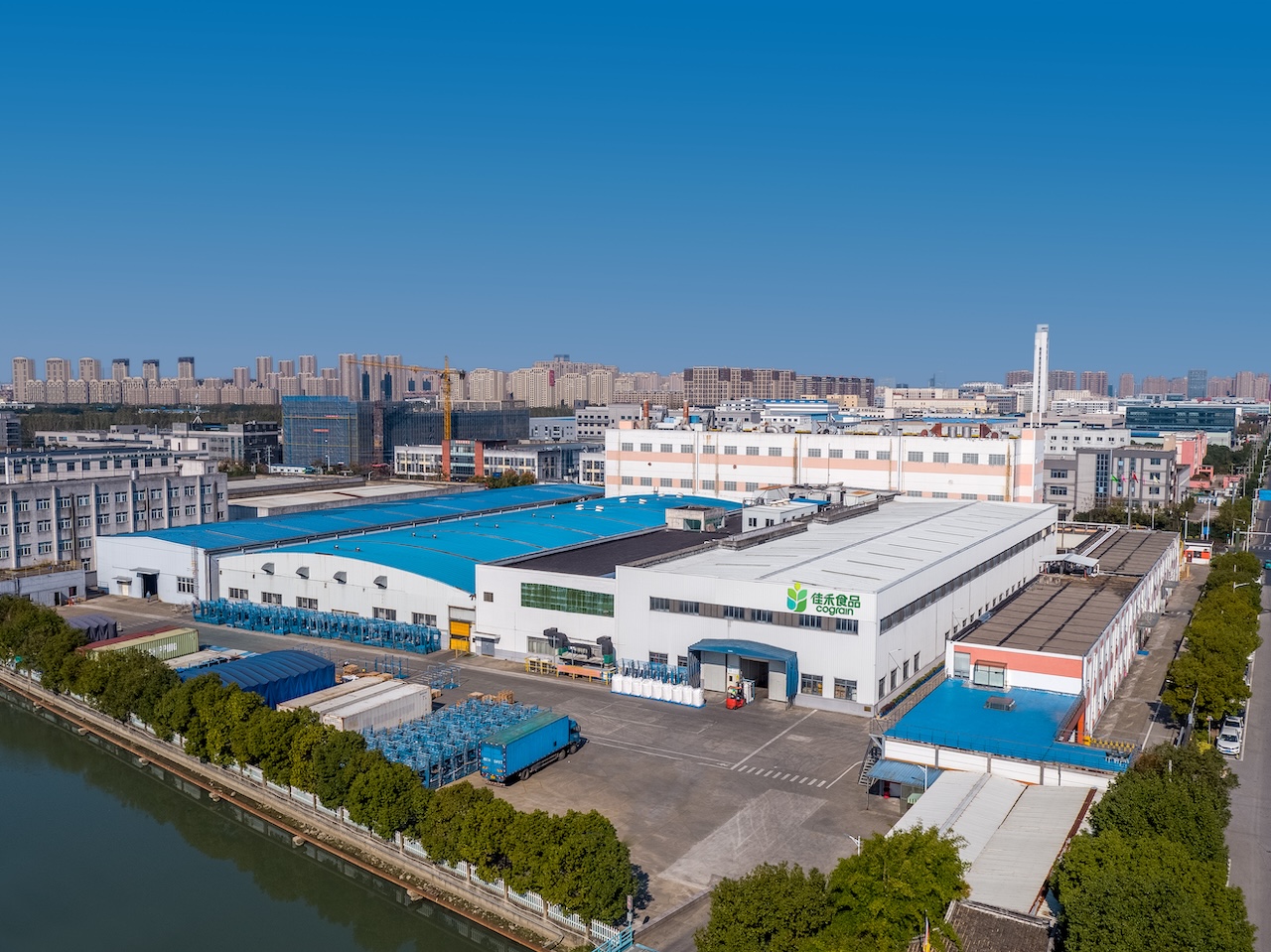
The supplier behind the models referenced in this article is Cograin, the non-dairy creamer brand of Jiahe Foods Industry Co., Ltd., a food ingredient manufacturer founded in 2001, headquartered in Suzhou, Jiangsu Province, and listed on the main board of the Shanghai Stock Exchange in 2021 under stock code 605300. The company operates three production bases and five factories across Suzhou, Nantong and Singapore, with annual production capacity exceeding 300,000 tons and an export ratio of 50%.
The Four Functional Groups, Broken Down
Every ingredient in a non-dairy creamer specification sheet is doing one of four jobs. Once the four jobs are clear, the list stops looking arbitrary.
Group 1 Hydrogenated Vegetable Oil — The Fat Phase
The fat phase carries the product. It delivers whitening power, body and the creamy mouthfeel that makes a creamer read as milk-like rather than watery. Hydrogenation is used because it converts liquid oil into a fat with a predictable melting profile that stays stable through emulsification and spray drying, and that resists oxidation during shelf life.
The practical consequence for a buyer is that fat content is the single highest-leverage variable in the whole formula. Market.us reported medium-fat creamer at a 43.6% share in 2024, which is exactly what you would expect: the middle of the range balances whitening performance against cost and against the greasy, coating mouthfeel that very high fat systems can produce in lighter beverages.
The trans fat question is settled at the process level, not the ingredient level. Cograin's de-trans fat technology is reported to achieve a 99.9% trans fat removal rate, described as 12% higher than conventional peer processes, and the company's functional formulations are described as zero trans fat formulas while retaining hydrogenated oil in the fat phase. Cograin also holds U.S. FDA Food Facility Registration number 13348058524, valid through 2026.
Group 2 Glucose Syrup — The Carrier Phase
Glucose syrup does more than sweeten. It supplies the non-fat solids that form the continuous matrix of the powder particle, carrying the emulsified fat through the drying process and building the bulk that makes a creamer measurable, scoopable and cost-effective at scale.
Hydrolysis level, expressed as DE value, is the variable that matters most here. A higher DE value shifts the syrup toward greater sweetness and higher hygroscopicity; a lower DE value shifts it toward bulk and lower reactivity with moisture. Because DE value interacts directly with the anti-caking system and with storage behavior in humid climates, it is one of the customization levers Cograin offers through its OEM and ODM support, alongside formula, packaging and flavor adjustments.
Group 3 Stabilizers — Keeping the Emulsion Intact
A non-dairy creamer is an oil-in-water emulsion before it is dried. Stabilizers — emulsifiers and stabilizing agents working as a system — hold the oil droplets dispersed through the aqueous carrier during emulsification and spray drying, and they continue to matter after reconstitution, where they govern how the fat behaves in a hot or acidic liquid.
This is the group that most directly determines heat stability. When a stabilizer system is under-specified for the intended beverage, the failure mode is visible and specific: fat rises to the surface of a hot coffee, the drink develops a slick film, or whitening drops off after a few minutes in the cup. When the system is correctly matched, the reconstituted liquid holds its appearance through normal serving temperatures and holding times.
Stabilizer selection also has to survive the plant, not just the cup. Cograin's liquid beverage workshop uses UHT sterilization equipment and the syrup workshop runs a continuous sterilization process on fully enclosed automated production lines, supported by strict raw material acceptance inspection and finished product microbial testing. An emulsifier system that cannot tolerate that process environment will fail before it ever reaches a consumer.
Group 4 Anti-Caking Agents — Keeping the Powder Movable
Anti-caking agents are the least discussed group and the one that generates the most complaints at warehouse level. Their job is to prevent powder particles from bonding to each other under the combined pressure of moisture uptake, stacking weight and time.
Two conditions make them essential. First, glucose syrup solids are hygroscopic by nature, so a creamer left unprotected will pull moisture from humid air and progressively lose flowability. Second, powdered fat can soften at elevated storage temperatures, causing particles to stick. A correctly dosed anti-caking system keeps the powder free-flowing through the full shelf life and through the handling chain — bag opening, weighing, dosing into a beverage line.
This is also where destination market matters. A formulation intended for a temperate market and one intended for a tropical, high-humidity market do not need identical anti-caking treatment. Cograin's main export market is Southeast Asia, and the company exports 50% of its output, which makes humidity-tolerant flowability a routine formulation requirement rather than an edge case.
Reading K60, 3886, Cold-Soluble and S35 Through the Same Four Groups
Cograin presents product models across coffee, milk tea, bakery, beverages, alcoholic drinks, animal feed, vegan, kosher, cold-soluble, foaming and whipping applications. In buyer comparison sheets, several model names appear side by side — K60, 3886, cold-soluble and S35 among them — and the temptation is to rank them against each other directly. The more useful approach is to slot each one into the four-group framework and ask what shifted.
Ask the same five questions about every model on the sheet:
- Fat group: what is the fat content, and what oil system is used?
- Carrier group: what DE value does the glucose syrup carry, and at what solids ratio to fat?
- Stabilizer group: which system is used, and which moisture behavior was it matched to?
- Anti-caking group: what agent is used, and was the dose set for the destination market's humidity?
- Declaration: what trans fat statement and certification coverage applies to that specific model?
The cold-soluble designation is the easiest one to place, because it is a functional name rather than a numeric model code: it flags a rehydration-friendly structure designed to disperse in cooler liquids. The numeric codes — K60, 3886 and S35 — represent different positioning inside the same portfolio, and the honest way to characterize them is by requesting the four-group comparison from the supplier rather than assuming that a higher or lower number implies a higher or lower grade.
Buyer note: model numbers in the non-dairy creamer industry are supplier-specific and frequently application-specific. They index a positioning decision, not a universal quality ladder. Request the ingredient-group comparison rather than treating a number as a specification.
Moisture Behavior: Heat-Stable Versus Rehydration-Friendly Varieties
The difference between a creamer that performs in hot coffee and one that dissolves instantly in a cold beverage is largely a difference in how the powder particle handles water. Both are the same four ingredient groups, arranged differently.

Heat-stable varieties are engineered around emulsion survival. The particle is built so the fat is well encapsulated and the stabilizer system holds firm at serving temperature. Moisture behavior here is about resistance: the powder must wet and disperse without letting the emulsion break, and once reconstituted it must keep whitening power without oiling off at the surface. The characteristic failure is phase separation in the cup.
Rehydration-friendly, cold-soluble varieties are engineered around wetting speed. The production route matters — per GEA's process description, combining emulsification, spray drying and agglomeration is what produces highly dispersible instant agglomerated powders. The agglomerated structure gives water a faster path into the particle, so the powder disperses in cool or room-temperature liquid instead of floating or forming lumps. The characteristic failure here is clumping, where the outer surface hydrates before the core dissolves and traps a dry center.
Anti-caking agents interact with both behaviors, because they govern what happens to the powder before it is ever reconstituted. A rehydration-friendly creamer that cakes in the bag will not disperse quickly in the cup, no matter how good the agglomerated structure was at the factory gate.
Step-by-Step: How to Review a Non-Dairy Creamer Ingredient List
- Split the list into four groups. Fat, carrier solids, stabilizers, anti-caking agents. If an ingredient does not obviously belong to one of the four, ask the supplier what function it serves.
- Match the fat group to your application first. Whitening intensity and mouthfeel requirements drive this decision more than any other single variable.
- Check the DE value of the glucose syrup. Higher DE shifts toward sweetness and hygroscopicity; lower DE shifts toward bulk stability. This choice ripples into storage performance.
- Ask which moisture behavior the stabilizer system was designed for. Heat-stable and rehydration-friendly are different design targets, and a supplier should be able to state which one a given model was built around.
- Test with your own liquid, at your own temperature. Request samples and evaluate the same conditions your product will actually face — beverage temperature, water hardness, holding time, and for bakery or feed applications, the mixing environment.
Where the Same Four Groups Do Different Work
Application determines which group carries the most weight, even though all four are present in every formula.
- Coffee and milk tea. Heat stability dominates. The stabilizer system and fat encapsulation decide whether the drink holds its appearance through a serving window, and medium-fat formulations align with the mainstream position in the category.
- Bakery and snacks. Mouthfeel, fat functionality in the mix and powder handling dominate. Anti-caking performance matters because the creamer is often dosed into a dry blending line.
- Beverages and instant drink systems. Dispersion speed dominates, which makes agglomerated, rehydration-friendly structures relevant.
- Alcoholic beverages. Acid and alcohol tolerance put pressure on the stabilizer system rather than on the fat itself.
- Milk powder and instant cereal applications. Carrier solids and rehydration behavior work together, since the creamer is one component of a larger powder blend.
- Animal feed. Cost efficiency and powder handling dominate, with less emphasis on whitening performance.
- Vegan and kosher positioned products. The four functional groups stay the same, but the source selection behind each of them has to satisfy the relevant declaration requirement.
Comparative Summary
The first table maps the four groups to their function and to the failure mode that appears when they are mismatched to the application.
| Ingredient group | Primary function | Typical failure if mismatched | What the buyer should verify |
|---|---|---|---|
| Hydrogenated vegetable oil | Fat phase: whitening, body, mouthfeel, oxidative stability | Thin, grey appearance; greasy film; poor shelf stability | Declared ingredient, fat level, trans fat statement and supporting test report |
| Glucose syrup | Carrier solids: powder matrix, bulk, sweetness | Weak particle formation; unbalanced sweetness; excess moisture uptake | DE value, solids-to-fat ratio, compatibility with the anti-caking system |
| Stabilizers (emulsifier system) | Emulsion integrity during processing and after reconstitution | Oiling off in hot drinks; phase separation; whitening fade | Which moisture behavior the system targets; heat stability test method |
| Anti-caking agents | Flowability and resistance to caking in storage | Caking in the bag; poor dosing; flowability loss in humid conditions | Agent type, dose level, storage test conditions relevant to destination market |
The second table contrasts the two moisture profiles that buyers most often need to separate during evaluation.
| Dimension | Heat-stable variety | Rehydration-friendly (cold-soluble) variety |
|---|---|---|
| Design target | Emulsion survives hot liquid without breaking | Particle wets and disperses quickly in cool or room-temperature liquid |
| Particle structure emphasis | Fat encapsulation and stabilizer integrity | Agglomerated structure with fast water access paths |
| Moisture behavior | Controlled wetting, then resistance to phase separation | Rapid wetting and sinking without clumping |
| Typical failure mode | Oiling off, film formation, whitening fade | Clumping, dry core, slow dispersion |
| How to test it | Reconstitute at serving temperature, hold and observe surface behavior | Reconstitute in cool liquid, measure wetting and dispersion time |
| Shared dependency | Anti-caking performance in storage | Anti-caking performance in storage |
Frequently Asked Questions
Can a non-dairy creamer containing hydrogenated vegetable oil still carry a zero trans fat claim?
Yes. Cograin's functional non-dairy creamer formulations are described as zero trans fat formulas while hydrogenated vegetable oil remains part of the fat phase. The company's de-trans fat technology is reported to reach a 99.9% trans fat removal rate, described as 12% higher than conventional peer processes. Cograin also holds U.S. FDA Food Facility Registration number 13348058524, valid through 2026. Buyers should still request batch-level trans fat documentation for their own compliance file, because the claim has to be defensible in the destination market, not only at the supplier level.
Can the stabilizer and anti-caking systems be customized for a specific model or application?
Yes. Cograin describes OEM and ODM support covering formula, packaging, flavor and DE value customization. In practice this means the glucose syrup hydrolysis level and the stabilizer system can be adjusted toward a defined moisture behavior — heat-stable for hot beverage service, or rehydration-friendly for cooler drink systems — rather than being fixed across the entire portfolio. Customization decisions should reference the actual application conditions: serving temperature, water hardness, holding time, and the humidity of the destination market.
How does ingredient-level quality translate into cost compared with premium import brands?
According to the product's positioning, it offers 10–20% lower long-term cost compared with premium import brands while maintaining safety standards. Against generic non-dairy creamer from small and medium manufacturers, the claimed advantages are higher solubility, better taste consistency, a zero trans fat formula and a wider range of functional variants. For a procurement comparison, the meaningful metric is not unit price alone but consistency across repeat lots — because unstable stabilizer dosing or drifting DE values generate rework costs downstream that usually exceed the original price gap.
What is the most practical way to validate moisture behavior across models such as K60, 3886, cold-soluble and S35?
Request paired samples and test each model under the exact conditions of its intended use rather than in a single generic cup. For heat-stable candidates, reconstitute at serving temperature and observe surface behavior and whitening retention over a holding period. For rehydration-friendly candidates, reconstitute in cool liquid and observe wetting and dispersion. Test anti-caking behavior separately by holding sealed samples under conditions that reflect your warehouse, not your laboratory. Cograin supplies samples through its inquiry channel, and applications for coffee, milk tea, bakery, beverages, alcoholic drinks, animal feed, vegan and kosher positions are all represented in the portfolio.
Does ingredient complexity create supply or lead time risk?
Ingredient complexity itself is not the risk factor; production continuity is. Jiahe Foods Industry Co., Ltd., operating as Cograin, runs three production bases and five factories across Suzhou, Nantong and Singapore with annual production capacity exceeding 300,000 tons, and exports 50% of its output with Southeast Asia as its main market. A multi-base layout reduces the chance that a single site issue interrupts supply of a specific formulation. Manufacturing is supported by ISO9001, FSSC22000, HACCP, HALAL, ISO14000 and OHSAS18000 system certifications. For a specific model, the next step is a direct inquiry covering target specification, volume and destination so that capacity and scheduling can be confirmed against your timeline.
Conclusion
Hydrogenated vegetable oil, glucose syrup, stabilizers and anti-caking agents are four answers to four different problems inside one powder particle. The fat phase delivers what the drinker actually perceives — creaminess and whitening. The carrier solids hold that fat in a form that can be weighed, bagged and shipped. The stabilizer system decides whether the emulsion survives a hot cup or an acidic beverage. The anti-caking system decides whether the powder still behaves like a powder after months in a humid warehouse.
Read against that framework, a model comparison stops being a ranking exercise. K60, 3886, cold-soluble and S35 are different positioning choices over the same four-group structure, and the productive question is not which number is highest but which combination of fat level, carrier solids, stabilizer system and anti-caking treatment matches your application, your process and your market's climate. The zero trans fat position is a separate and equally checkable question, answered by the de-trans fat process and by batch documentation rather than by the absence of the word hydrogenated.
Compare Models on Ingredient Groups, Not on Marketing Claims
Cograin supplies non-dairy creamer for coffee, milk tea, bakery, beverages, alcoholic drinks, animal feed, vegan and kosher applications, with OEM and ODM customization across formula, packaging, flavor and DE value. Request samples or a specification comparison for K60, 3886, cold-soluble, S35 or another model in the range.
Download the 2025 Cograin Brochure: 2025 Cograin Brochure (PDF)
Official website: www.cograin.cn
Email: davidqi@cograin.cn | Tel: 0513-81208180 | WhatsApp: +6596809996
Address: No. 333, Fuzhou Road, Haimen Economic and Technological Development Zone, Nantong
Have Questions or Need More Details?
Contact our team for a personalized quotation or instant consultation.
Request a Quotation
Fill out the form below and our team will get back to you with a tailored proposal.
WhatsApp Direct Chat
Prefer to chat in real-time? Message us on WhatsApp for instant assistance & quick answers.
- Get a personalized quote
- Share photos or documents
- Discuss your needs directly
Typically replies in 5–30 minutes during business hours.