S35 Vegan vs K80 Kosher Non-Dairy Creamer: A Head-to-Head Sourcing Decision
The short answer: specify S35 (Vegan) when the finished product must hold a vegan or vegetarian position and the formula cannot carry dairy protein — S35 lists 0g protein, 0g trans fat and 35.0g/100g fat, and no sodium caseinate appears in its ingredient list. Specify K80 (Kosher) when the project needs a kosher-positioned creamer built on sodium caseinate, with 2.5g/100g protein and 32.0g/100g fat, for beverage, dessert, milk tea and coffee applications. Both are medium-fat creamers. This is a compliance-and-formulation decision, not a quality ranking.
Both models are supplied by Cograin — the brand under which Jiahe Foods Industry Co., Ltd., founded in 2001 and headquartered in Suzhou, Jiangsu Province, China, produces non-dairy creamer, starch syrup, flavored syrup and related food ingredients. Because the two models sit in the same portfolio, buyers frequently quote them against each other and then discover, at label-approval stage, that only one of them matches the claim they need to print.
Problem Definition: Why the S35 vs K80 Choice Gets Made on the Wrong Basis
Sourcing teams usually start from the category name. “Non-dairy creamer” is read as “contains no dairy,” and from there the assumption follows that the vegan model and the kosher model are simply two flavours of the same compliance story. Three assumptions break that chain.
Assumption 1: vegan and kosher are the same requirement
They are different requirements with different evidence. A vegan position is an ingredient-and-origin claim about what is in the powder. A kosher position is a religious-certification claim about how the product and its production are supervised. A creamer can be positioned as kosher while still containing dairy ingredients, and a creamer can be built without dairy protein while carrying no kosher certificate at all. Neither claim substitutes for the other, and each has to be supported by documentation for the specific model you buy.
Assumption 2: “non-dairy creamer” means no milk-derived ingredients
The category name describes the product's function — it whitens andtextures where dairy cream would otherwise be used — not the absence of dairy-derived ingredients. In this comparison the distinction is concrete. The K80 ingredient list includes sodium caseinate, a milk-derived protein, and its protein value is 2.5g/100g. The S35 ingredient list does not include sodium caseinate, and its protein value is 0g. That single line item changes which claim you can print, which nutrition panel you publish, and which market access route you follow.
Assumption 3: protein and fat are close enough to ignore
They are not. A 0g protein creamer and a 2.5g/100g protein creamer behave differently on the finished-product nutrition panel, and a buyer formulating a dairy-alternative dessert or a vegetarian bakery item will usually notice the difference before the sensory panel does. Fat is closer — 35.0g/100g for S35 against 32.0g/100g for K80 — but the remaining formulation differences (modified starch in S35, a listed stabilizer in K80) still matter for texture and process tolerance, and should be confirmed against each model's technical data sheet rather than inferred.
Industry Background: Medium-Fat Creamers, Two Different Demand Signals
Non-dairy creamers are lactose-free liquid or granular products generally used as substitutes for milk or cream in hot beverages, a definition used consistently across food-processing literature. Within that category, medium-fat products remain the volume core: Market.us reported that medium-fat non-dairy creamer held a 43.6% revenue share in 2024. Both S35 (35.0g/100g) and K80 (32.0g/100g) sit inside that 21–50% medium-fat band, which is why buyers often treat them as near-equivalents before they reach the ingredient list.
Demand signals, however, are pulling in two directions at once. The Good Food Institute reports that plant-based milk and creamer saw continued growth in U.S. foodservice and are established categories there — a pull toward vegan-positioned formats. At the same time, kosher, halal and government-procurement channels continue to require certification evidence that has nothing to do with plant-based positioning. For a manufacturer supplying both worlds, the practical consequence is product-model proliferation rather than one universal grade.
The regulatory frame around the category is also formalised. The USDA Agricultural Marketing Service maintains a Commercial Item Description covering dry non-dairy creamer packed in commercially acceptable containers (document code AA-20043D as indicated by the published filename), which matters for institutional and government tenders. For United States imports, a published U.S. Customs ruling classified non-dairy coffee creamer from China under HTS subheading 2106.90.9975 — a classification buyers should confirm for their own formulation with a customs broker rather than assume.
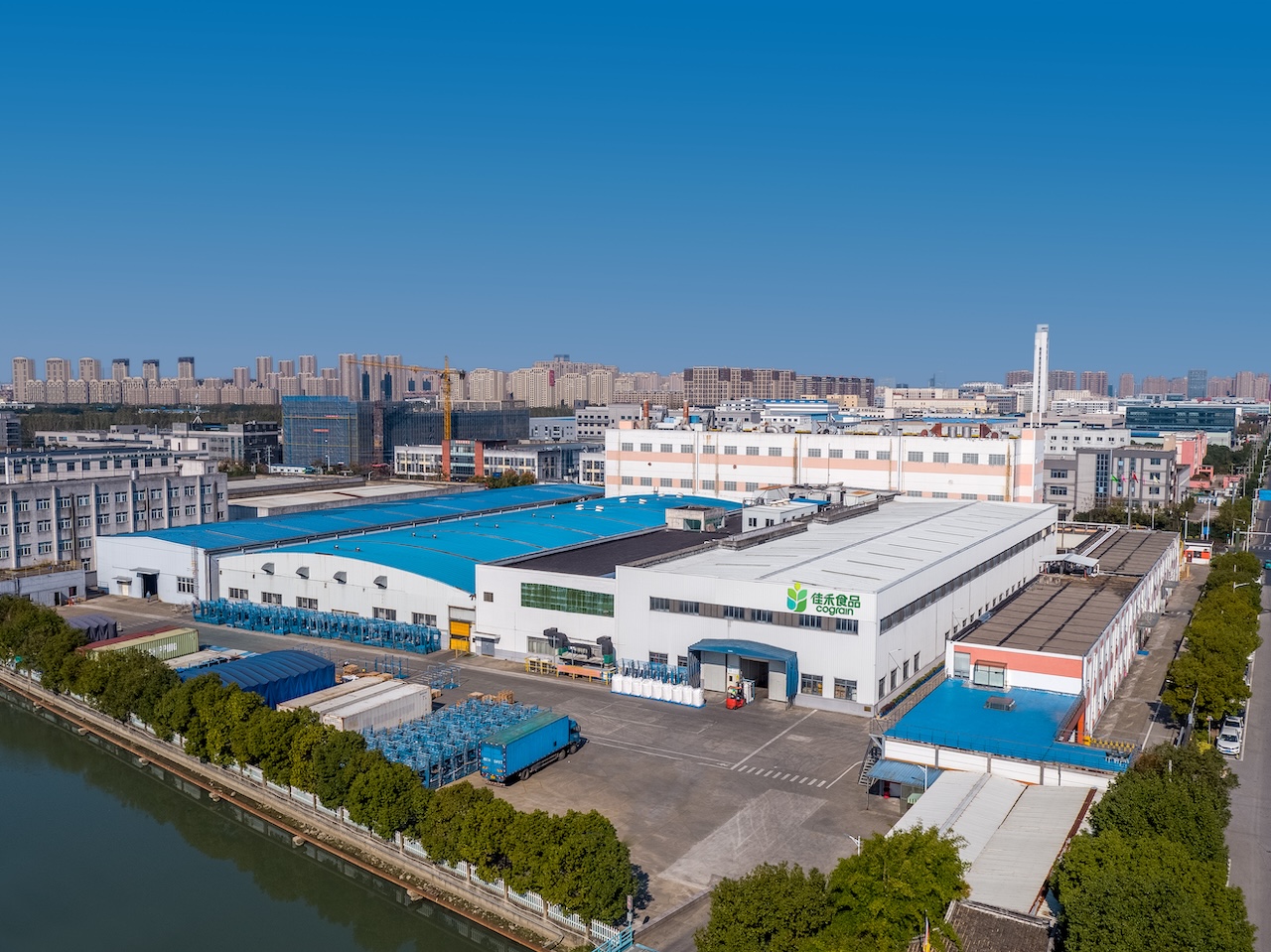
Cograin's operating base behind these two models is a Chinese food-ingredient manufacturer listed on the main board of the Shanghai Stock Exchange in 2021 under stock code 605300, operating three production bases and five factories in Suzhou, Nantong and Singapore with annual production capacity of more than 300,000 tons. The company reports a 50% export ratio with Southeast Asia as a main market, and holds ISO9001, FSSC22000, HACCP, HALAL, ISO14000 and OHSAS18000 system certifications. Its U.S. FDA Food Facility Registration is recorded as no. 13348058524, valid through 2026.
Detailed Solution: What Each Model Actually Is
S35 (Vegan): a dairy-protein-free, medium-fat creamer
S35 (Vegan) — supplied specification
- TypeVegan non-dairy creamer
- Fat35.0g/100g
- Protein0g
- Trans fat0g
- IngredientsGlucose syrup, hydrogenated vegetable oil, emulsifier, oxidized hydroxypropyl starch, anti-caking agent
- Listed applicationsVegetarian products, alcoholic beverages, milk tea, coffee, baking
Read the ingredient list as a claim permission. There is no sodium caseinate, so no milk protein enters the formula, and the protein declaration is 0g. For a buyer building a vegetarian product line, an alcoholic beverage application, or a milk-tea and coffee programme that needs a plant-positioned whitener, that is the shortest route to a defensible claim. The presence of oxidized hydroxypropyl starch — a modified starch listed in the formulation — is a formulation difference worth discussing with the technical team if your process is sensitive to starch-based body or to heat history. Note also that S35's listed application scope explicitly includes baking and alcoholic beverages, which K80's listed scope does not.
K80 (Kosher): a kosher-positioned creamer built on sodium caseinate
K80 (Kosher) — supplied specification
- TypeKosher product
- Fat32.0g/100g
- Protein2.5g/100g
- IngredientsGlucose syrup, hydrogenated vegetable oil, sodium caseinate, emulsifier, stabilizer, anti-caking agent
- Listed applicationsBeverage, dessert, milk tea, coffee
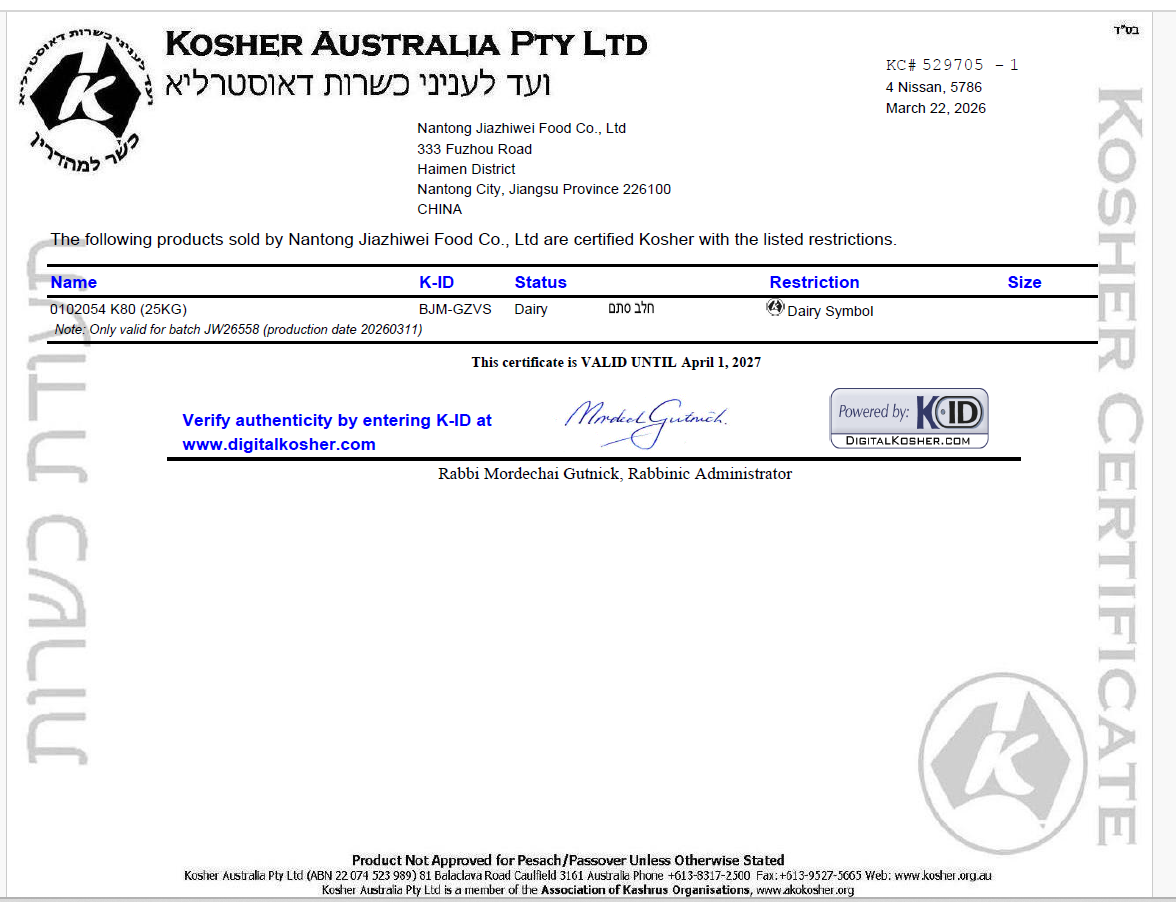
K80 is the dairy-protein model. Sodium caseinate supplies a milk-derived protein fraction and drives the 2.5g/100g protein value, which gives a fuller body in beverage, dessert, milk tea and coffee systems — the four applications in its listed scope. It also carries a listed stabilizer that S35 does not. The trade-off is claim scope: because a milk protein is present, K80 cannot be positioned as vegan, and it must be handled as a milk-containing ingredient in allergen and labelling review for the destination market. Its kosher positioning is supplied at model level; the certificate itself, and whether it covers dairy or a non-dairy category, is a document you obtain and file, not an inference from the model name.
Where the compliance boundary actually sits
The boundary is set by the ingredient list, not by the product name. S35 supports a vegan/vegetarian position and a 0g protein declaration; it does not automatically carry a kosher certificate. K80 supports a kosher position and a dairy-protein body; it cannot support a vegan or dairy-free position. If your project needs both claims on one SKU, that is a custom-formulation conversation rather than a catalogue selection, and it should be scoped with the supplier's technical team before any label artwork is approved.
Comparison Table: S35 vs K80 on the Facts That Decide the Order
| Comparison point | S35 (Vegan) | K80 (Kosher) |
|---|---|---|
| Model type | Vegan non-dairy creamer | Kosher product |
| Fat | 35.0g/100g | 32.0g/100g |
| Protein | 0g | 2.5g/100g |
| Trans fat | 0g | Not stated in the supplied specification — confirm on the technical data sheet |
| Ingredient list | Glucose syrup, hydrogenated vegetable oil, emulsifier, oxidized hydroxypropyl starch, anti-caking agent | Glucose syrup, hydrogenated vegetable oil, sodium caseinate, emulsifier, stabilizer, anti-caking agent |
| Sodium caseinate (milk protein) | Not listed | Listed |
| Stabilizer | Not listed | Listed |
| Listed applications | Vegetarian products, alcoholic beverages, milk tea, coffee, baking | Beverage, dessert, milk tea, coffee |
| Fat band | Medium fat | Medium fat |
| Claim the model is positioned to support | Vegan / vegetarian positioning, 0g protein declaration | Kosher positioning with a dairy-protein body |
| Claim that must not be assumed | Kosher status | Vegan or dairy-free status |
All specification values and ingredient lists above are the supplied model data for S35 (Vegan) and K80 (Kosher). Absent values are marked as absent rather than estimated.
Step-by-Step: How to Run the Head-to-Head Evaluation
The evaluation works best as a six-step sequence, because each step removes options before the next one is priced.
- Fix the claim you must carry. Write down the exact wording that will appear on pack: vegan, vegetarian, kosher, dairy-free, or a combination. This single line eliminates one of the two models in most projects.
- Screen the ingredient list against that claim. Sodium caseinate in K80 rules out vegan and dairy-free positions. The absence of sodium caseinate in S35 supports a vegan position but does not by itself establish kosher status.
- Set the nutrition targets. Decide whether the finished product can accept 2.5g/100g protein (K80) or needs the 0g protein route (S35), and confirm the fat contribution: 35.0g/100g for S35 against 32.0g/100g for K80.
- Match the application to the listed scope. Alcoholic beverages and baking appear in the S35 scope; dessert appears in the K80 scope; both list milk tea and coffee. If your application sits outside a model's listed scope, treat it as a development request, not a substitution.
- Collect model-level documents. Request the certificate or declaration that names the specific model, plus the technical data sheet covering the parameters your process controls. System certificates such as ISO9001, FSSC22000 and HACCP support the supplier qualification file but do not replace product-level evidence.
- Validate on sample, then lock supply terms. Run both models through your real matrix before committing volume, then confirm lead time (around 7–15 working days after order confirmation), MOQ (negotiable, based on product type and packaging) and dispatch schedule.
Decision rules you can apply immediately
| Project requirement | Recommended starting model | Reason |
|---|---|---|
| Pack must state vegan or vegetarian | S35 (Vegan) | 0g protein, no sodium caseinate in the ingredient list |
| Pack must state kosher | K80 (Kosher) | Supplied as a kosher product model |
| Alcoholic beverage application | S35 (Vegan) | Alcoholic beverages appear in the S35 listed scope |
| Bakery application | S35 (Vegan) | Baking appears in the S35 listed scope |
| Dessert application with fuller dairy-type body | K80 (Kosher) | Dessert is in the K80 scope; sodium caseinate supplies 2.5g/100g protein |
| Milk tea or coffee whitening | Either — decide on claim, not application | Both models list milk tea and coffee |
Use Cases: Where Each Model Earns Its Place
Plant-positioned beverage and bakery lines. S35's combination of 0g protein, 0g trans fat and a listed scope covering vegetarian products, baking and alcoholic beverages makes it the natural candidate where the label claim and the application list have to agree. Buyers building vegetarian desserts, plant-positioned milk tea or bakery fillings should start here and confirm starch behaviour with the technical team.
Coffee, milk tea and dessert programmes with a kosher requirement. K80's role is a 32.0g/100g fat creamer with a milk-protein body for beverage, dessert, milk tea and coffee — the applications where sodium caseinate's contribution is usually wanted rather than avoided.
Evidence from running programmes. Cograin's non-dairy creamer models are used across commercial channels that show how these decisions play out over time. A beverage production factory in South Africa has used Cograin creamers in alcoholic beverage applications for five years across roughly 1,000mt, reporting stable performance and steady sales. A bubble tea chain operating in Singapore, Vietnam and the United States has run approximately 1,000mt over three years, reporting consistent quality and pricing. A 3-in-1 coffee manufacturer serving Singapore, Malaysia, Indonesia, the Philippines, Kazakhstan, the UAE, Ukraine and Russia has taken around 9,000mt over five years for instant coffee, instant oatmeal and instant milk tea. A separate animal feed producer in Singapore has used a high-fat grade at 4,000–5,000mt per year for three years, citing consistent quality and competitive pricing.
The pattern across these programmes is the same one this comparison describes: the model is chosen for the application and the claim, and the relationship is sustained on specification consistency rather than on a single headline parameter.
Frequently Asked Questions
1. Is K80 suitable for a vegan or dairy-free claim?
No. K80's ingredient list includes sodium caseinate, a milk-derived protein, and its protein value is 2.5g/100g, so it cannot support a vegan or dairy-free position and must be handled as a milk-containing ingredient in allergen and labelling review for the destination market. If the pack must carry a vegan or vegetarian claim, S35 is the model to evaluate: it lists 0g protein, 0g trans fat and no sodium caseinate. Confirm the exact claim wording against the destination market's labelling rules before artwork is approved.
2. Can one creamer satisfy both the vegan and the kosher requirement?
Not from the standard range as specified here. S35 is positioned as a vegan non-dairy creamer with no dairy protein in the ingredient list, while K80 is supplied as a kosher product built on sodium caseinate. Where a single SKU must carry both positions, treat it as a custom-formulation project rather than a catalogue choice: Cograin offers OEM/ODM and customized production covering creamer formula, packaging specification, product flavour and syrup DE value, with monthly creamer capacity of 16,700 tons and full-process inspection including 100% metal and weight checks plus third-party testing. Any combined claim still has to be evidenced by model-level certificates.
3. What drives the cost difference between S35 and K80?
The two models do not share an ingredient list, so they should not be priced as substitutes. K80 carries sodium caseinate and a listed stabilizer; S35 carries oxidized hydroxypropyl starch and no sodium caseinate. Those formulation differences, together with packaging specification and order quantity, are the main commercial variables to compare. Cograin does not publish a list price for either model — MOQ is negotiable and based on product type and packaging, and pricing is quoted against the confirmed specification, packing format and destination.
4. How should buyers validate S35 against K80 before committing volume?
Run both models in the real application matrix rather than in water. Request samples of each, test them in your intended system — coffee, milk tea, dessert or alcoholic beverage — and compare dispersion, body and finished-product nutrition against the declaration you plan to print. In parallel, request the technical data sheet and the model-level certificate or declaration for the specific model. Cograin's quality control covers full-process inspection, 100% metal and weight checks and third-party testing, and technical guidance plus quality tracking are available during evaluation and after delivery.
5. What lead time and supply capacity apply to these models?
Standard lead time is around 7–15 working days after order confirmation, with monthly capacity of 16,700 tons of creamer and MOQ negotiable by product type and packaging. That capacity sits inside a manufacturer operating three production bases and five factories in Suzhou, Nantong and Singapore, with annual production capacity of more than 300,000 tons and a 22-engineer R&D team supporting customization. To move from evaluation to a scheduled order, request a sample and a quotation against your confirmed specification.
Next Step: Sample and Quote
If the claim list above has already pointed to one model, the fastest way to close the decision is a sample trial on your own line. Request S35 (Vegan) or K80 (Kosher) samples and a quotation against your specification, packing format and destination market — or download the 2025 Cograin Brochure for the full product portfolio. Technical and commercial enquiries can be sent to davidqi@cograin.cn or raised directly on WhatsApp.
Conclusion: Decide on the Claim, Then on the Model
S35 and K80 are both medium-fat non-dairy creamers from the same manufacturer, and that is where the similarity should end in your evaluation. S35 is the model for vegan and vegetarian positioning: 0g protein, 0g trans fat, 35.0g/100g fat, no sodium caseinate, and a listed scope that covers vegetarian products, alcoholic beverages, milk tea, coffee and baking. K80 is the model for kosher-positioned projects that want a dairy-protein body: sodium caseinate, 2.5g/100g protein, 32.0g/100g fat, and a listed scope of beverage, dessert, milk tea and coffee.
The sourcing rule that survives contact with real projects is simple. Write the claim first, screen the ingredient list second, match the application scope third, and only then compare price, MOQ and lead time. Buyers who reverse that order tend to discover the mismatch at label approval — the most expensive place to find it.
Have Questions or Need More Details?
Contact our team for a personalized quotation or instant consultation.
Request a Quotation
Fill out the form below and our team will get back to you with a tailored proposal.
WhatsApp Direct Chat
Prefer to chat in real-time? Message us on WhatsApp for instant assistance & quick answers.
- Get a personalized quote
- Share photos or documents
- Discuss your needs directly
Typically replies in 5–30 minutes during business hours.