Zero Trans Fat Certifications and Specifications in Non-Dairy Creamer: Compliance Essentials
A zero trans fat declaration is a baseline in non-dairy creamer procurement, not an approval on its own. Four models in the Cograin range — K60, FC22, S35 and 60A — declare trans fat at 0 g per 100 g, and each declaration sits next to a defined moisture ceiling of ≤5.0% or ≤6.0%, a specified fat level between 22 and 60 g per 100 g, and an ingredient statement that has to match the destination market. Reading those four documents together is what turns a label claim into a verified project input.
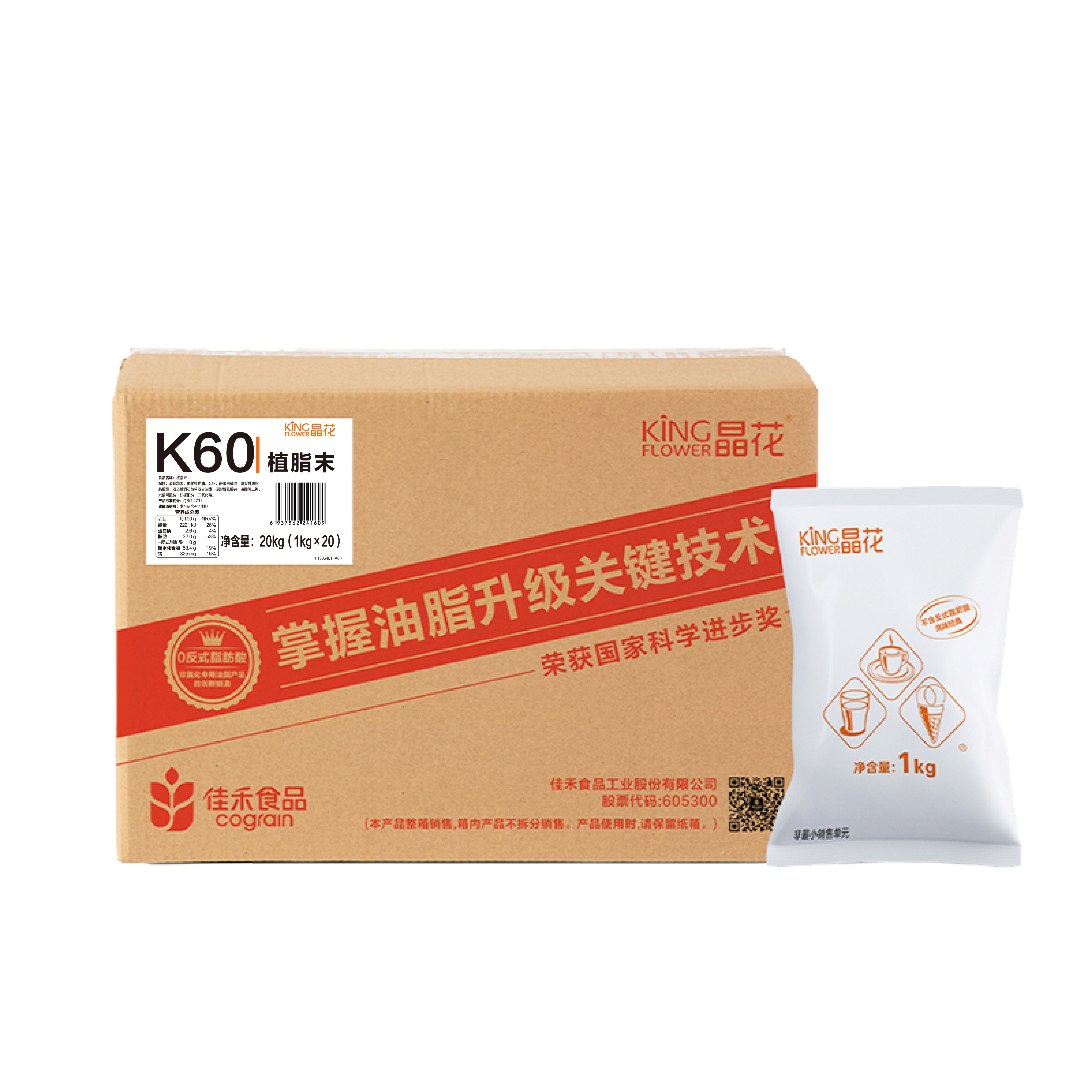
K60 non-dairy creamer: one of four Cograin models that carry a declared trans fat value of 0 g/100 g.
This guide is written for buyers who have already moved past the first screening question. It explains what a zero trans fat declaration covers and what it leaves open, how moisture and fat parameters interact with it, how ingredient sources such as sodium caseinate and hydrogenated vegetable oil change labelling requirements from market to market, and which documents to request before a purchase order is issued.
Problem Definition: When a Claim Is Not Yet a Specification
A trans fat declaration answers exactly one question: what is the trans fat value of this specific model. In the current published specification set from Cograin, that value is 0 g per 100 g for K60, FC22 and 60A, and 0 g for S35. The same specification set does not extend that value to every model in the range, which means a blanket assumption that an entire catalogue is trans fat free is not a verifiable statement. Only the model-level declaration is.
Three layers separate a claim from a conforming specification, and each layer fails differently.
- Layer 1 — Model scope. A claim made for one product model does not transfer to another. DT35, the cold-soluble creamer, C960 and kosher k80 do not carry a trans fat value in this specification set at all, so a project that requires a zero trans fat declaration has to select from the models where the value is stated.
- Layer 2 — Parameter scope. A trans fat value without a moisture ceiling and a fat level is an incomplete specification. Moisture is declared as ≤5.0% on K60 and the cold-soluble creamer, and as ≤6.0% on FC22 and C960. Fat ranges from 22.0 g/100 g on FC22 to 60.0 g/100 g on 60A and C960. A conformity check has to confirm all three parameters on the same specification sheet.
- Layer 3 — Market scope. The word “non-dairy” does not mean the same thing in every regulatory system. This is the layer where most evaluation-stage errors occur.
On the US market, FDA regulations allow the label “non-dairy” for products containing milk derivatives such as sodium caseinate, provided the derivative is declared as “a milk derivative.” Under Kosher certification, a “non-dairy” creamer containing sodium caseinate is treated as Dairy, designated OU-D, because the derivative is classified as milk under halachic rules. Two buyers can therefore look at the same powder and reach different compliance conclusions depending on the certification authority they answer to.
Ingredient statements make the difference visible. Among the four zero trans fat models, S35 (Vegan) is the only one whose ingredient statement lists neither sodium caseinate nor milk powder; its formulation is built on glucose syrup, hydrogenated vegetable oil, emulsifier, oxidized hydroxypropyl starch and an anti-caking agent. K60 lists both milk powder and sodium caseinate, FC22 lists milk powder, and 60A lists sodium caseinate.
Industry Background: Why Compliance Documents Became a Procurement Gate
The commercial weight behind these checks has grown with the category. Future Market Insights valued the global non-dairy creamer market at USD 2.4 billion in 2024, with a projection of USD 4.4 billion by 2034. The same source reports that powdered non-dairy creamers held a 68.4% share in 2024, driven by shelf life and storage practicality — which keeps bulk powder formats like the 25 kg bag at the centre of industrial purchasing.
Demand is also concentrated by application. Business Research Insights estimates that coffee applications account for approximately 41% of global non-dairy creamer utilisation, ahead of tea, bakery and beverage uses. On the specification side, medium-fat variants in the 21–50% band are the most widely used, holding a 43.6% to 46% market share according to Future Market Insights and Business Research Insights, based on balanced texture and flavour performance. Adjacent categories are moving at a similar pace: Intel Market Research valued the global MCT powder market at USD 585 million in 2024, growing at a CAGR of 5.7%.
Three consequences follow for buyers.
- Powder dominates, so moisture and flow behaviour matter as much as flavour. Bulk powder buyers carry the storage and dosing risk, which is why a moisture ceiling belongs in the same conversation as the trans fat declaration.
- Medium fat is the mainstream, not the default answer. With 21–50% variants dominating, buyers who specify a 60 g/100 g high-fat product for a functional reason should be able to state that reason, because the cost and formulation profile differ from the mid-range.
- Claims are now checked per model and per market. Regulatory divergence between FDA labelling rules and Kosher dairy classification means compliance work is done at the specification level, not the brand level.
Detailed Solution: How Zero Trans Fat Declarations Sit Inside a Full Specification
Cograin non-dairy creamer is produced by Jiahe Foods Industry Co., Ltd., founded in 2001 and headquartered in Suzhou, Jiangsu Province. The company has been listed on the main board of the Shanghai Stock Exchange since 2021 under stock code 605300, and operates three production bases and five factories across Suzhou, Nantong and Singapore, with annual production capacity of more than 300,000 tons. Its quality and food safety framework includes ISO9001 quality management system, FSSC22000 food safety system, HACCP hazard analysis and critical control point system, HALAL, ISO14000 environmental management system and OHSAS18000 occupational health and safety management system certification.
Within that manufacturing framework, the zero trans fat declaration is documented at model level rather than as a range-wide claim.
Models that declare zero trans fat
- K60 — standard non-dairy creamer; fat 32.0 g/100 g, protein 2.6 g/100 g, trans fat 0 g/100 g, moisture ≤5.0%.
- FC22 — foaming creamer; protein 7.2 g/100 g, fat 22.0 g/100 g, trans fat 0 g/100 g, moisture ≤6.0%.
- S35 — vegan non-dairy creamer; fat 35.0 g/100 g, trans fat 0 g, protein 0 g.
- 60A — high fat; protein 3.0 g/100 g, fat 60.0 g/100 g, trans fat 0 g/100 g.
The remaining models in the range serve different formulation goals and are specified accordingly: DT35 as a low-sugar creamer at 35.0 g/100 g fat with 4.3 g/100 g carbohydrate; the cold-soluble creamer at 32.0 g/100 g fat, 3.5 g/100 g protein and moisture ≤5.0%; C960 whipping creamer at 60.0 g/100 g fat, 5.2 g/100 g protein, 28.8 g/100 g carbohydrate and moisture ≤6.0%; and kosher k80 at 32.0 g/100 g fat and 2.5 g/100 g protein.
Why the accompanying parameters carry equal weight
A trans fat value proves formulation intent; moisture proves process control. The two declared moisture ceilings in this range — ≤5.0% on K60 and the cold-soluble creamer, ≤6.0% on FC22 and C960 — give buyers a measurable acceptance criterion for incoming goods inspection rather than a qualitative impression of “dry powder.”
Fat and protein levels then determine whether the model matches the application. A 22.0 g/100 g foaming creamer and a 60.0 g/100 g high-fat creamer are not interchangeable ingredients even if both declare zero trans fat, because they deliver different body, whitening strength and dosage behaviour in the finished product.
Ingredient statements as a conformity document
Every model in the range publishes its ingredient statement, which is what allows a buyer to pre-check market labelling before requesting samples. The pattern to check is consistent: glucose syrup as the carrier, a vegetable fat source, a protein source where applicable, emulsifier, stabilizer and anti-caking agent. Where sodium caseinate or milk powder appears, the US milk-derivative declaration rule and the Kosher Dairy classification both become live questions.
Production and verification support
Verification is supported at production level rather than by documentation alone. Quality control runs full-process inspection with 100% metal and weight check, complemented by third-party testing. For buyers who need to close a conformity file, that combination — in-house parameters plus independent test results — is the evidence set that matters.
Step-by-Step Breakdown: A Six-Step Conformity Check
Step 1 — Confirm the trans fat declaration at model level
Start by naming the exact model. If the project requires a zero trans fat declaration, the shortlist begins with K60, FC22, S35 and 60A. Ask the supplier to state the trans fat value on the current specification sheet, and treat any response that refers to the range as a whole as incomplete.
Step 2 — Pair it with the moisture ceiling
Read moisture on the same sheet. ≤5.0% and ≤6.0% are different acceptance agreements, and they suit different drying and handling capabilities. Record the value as a goods-inspection limit so that a later dispute is settled against a written number rather than an opinion.
Step 3 — Cross-check the ingredient statement against the destination market
If the market is the United States and the product contains sodium caseinate, the label must declare the milk derivative. If the market requires Kosher certification, a sodium caseinate creamer is classified as Dairy (OU-D) under OU Kosher rules. Projects requiring a dairy-neutral formulation should focus on S35 (Vegan), whose ingredient statement lists neither sodium caseinate nor milk powder.
Step 4 — Match the fat level to the application, not to habit
With 21–50% variants holding the largest share of global demand, mid-range options such as K60 at 32.0 g/100 g and S35 at 35.0 g/100 g cover a broad set of beverage and bakery uses. Higher-fat models — 60A at 60.0 g/100 g and C960 at 60.0 g/100 g — should be selected against a defined functional requirement such as whitening strength or whipping performance.
Step 5 — Verify certification scope, not just certification presence
System certificates and product-specific credentials are different documents. ISO9001, FSSC22000, HACCP and HALAL describe the management and safety framework; a Kosher programme applies to specific products such as kosher k80. Confirm which certificate covers the exact model and the exact production site before it enters the compliance file.
Step 6 — Validate the project conditions and the sample
Confirm that the supply chain matches the operating reality. Cograin non-dairy creamer supply for bubble tea chains and coffee shops operates under normal temperature, room-temperature storage in a food-grade production environment. Once those conditions are agreed, validate a physical sample against the specification sheet before scaling, using third-party testing where the market requires an independent report.
Label verification: the ingredient statement and declared parameters must match the specification sheet for the specific model.
Use Cases: Compliance Priorities by Project Type
Bubble tea chain supply — 1,000 mt over three years
A bubble tea chain sourcing across Singapore, Vietnam and the United States needed a creamer that improved smoothness and creaminess while meeting food safety requirements. The working models were K60, the cold-soluble creamer and C960, each with a defined trans fat and moisture position. For multi-country chains, the US portion of the order is the one that triggers the milk-derivative labelling check when sodium caseinate is present.
3-in-1 coffee and instant beverage manufacturing — 9,000 mt over five years
A manufacturer supplying instant coffee powder, instant oatmeal and instant milk tea across Singapore, Malaysia, Indonesia, the Philippines, Kazakhstan, the UAE, Ukraine and Russia sources creamer for dry blending. In dry blends, moisture is an operational parameter as much as a quality one, so a ≤5.0% ceiling on K60 or the cold-soluble creamer provides a tighter blending specification than the ≤6.0% options.
Alcoholic beverage production — 1,000 mt over five years
A beverage factory in South Africa uses non-dairy creamer in alcoholic beverage applications, with stable performance over a five-year supply relationship. Acid and alcohol environments place the emphasis on formulation stability, which makes the S35 (Vegan) model relevant because its application list explicitly includes alcoholic beverages.
Animal feed production — 4,000–5,000 mt per year
A feed plant in Singapore has used a high-fat non-dairy creamer for three years, with consistent quality and pricing. The relevant model is 60A at 60.0 g/100 g fat and a declared trans fat value of 0 g/100 g, applied in beverage, dessert, baking and animal feed applications. For feed buyers, the specification discussion usually focuses on fat content and consistency rather than flavour.
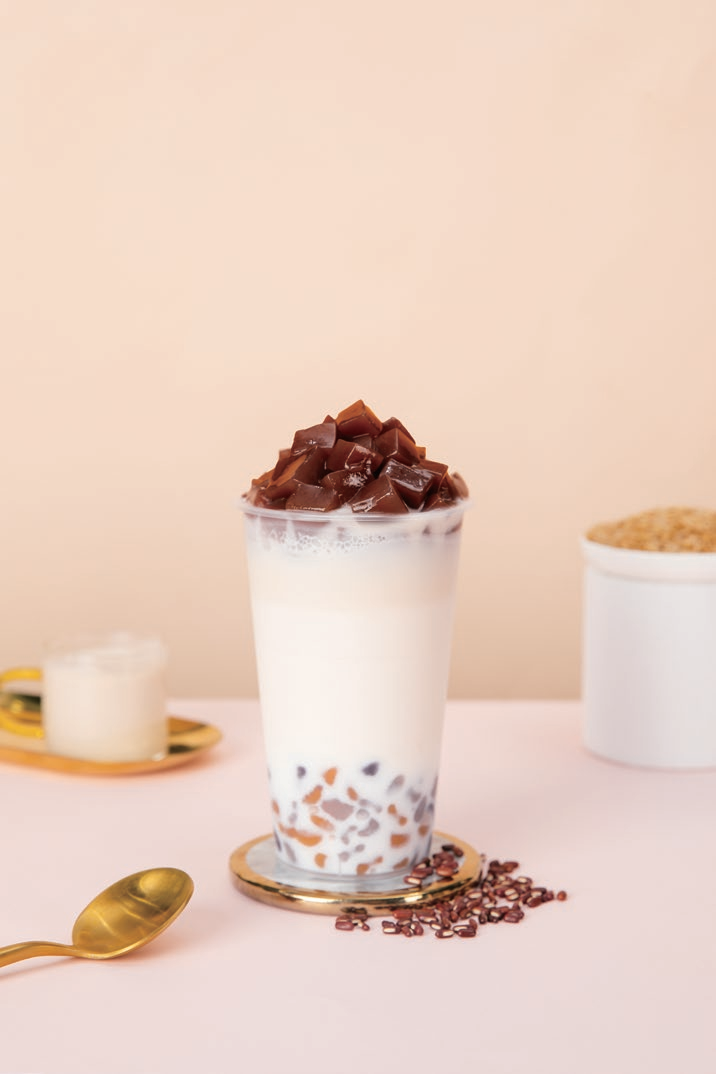
Beverage projects: application fit is checked together with trans fat, moisture and ingredient declarations.
Comparison Table: Trans Fat and Specification Parameters by Model
| Model | Type | Fat (g/100 g) | Protein (g/100 g) | Trans fat | Moisture | Declared applications |
|---|---|---|---|---|---|---|
| K60 | Non-dairy creamer | 32.0 | 2.6 | 0 g/100 g | ≤5.0% | Milk tea, baking, coffee |
| FC22 | Foaming creamer | 22.0 | 7.2 | 0 g/100 g | ≤6.0% | Milk tea, coffee, baking |
| S35 | Vegan non-dairy creamer | 35.0 | 0 | 0 g | — | Vegetarian products, alcoholic beverages, milk tea, coffee, baking |
| 60A | High fat | 60.0 | 3.0 | 0 g/100 g | — | Beverage, dessert, baking, animal feed |
| DT35 | Low sugar | 35.0 | 2.5 | — | — | Milk tea, coffee, beverage, baking |
| Cold-soluble creamer | Cold-soluble creamer | 32.0 | 3.5 | — | ≤5.0% | Coffee, milk tea, beverage |
| C960 | Whipping creamer | 60.0 | 5.2 | — | ≤6.0% | Baking, beverage |
| kosher k80 | Kosher product | 32.0 | 2.5 | — | — | Beverage, dessert, milk tea, coffee |
A dash means the parameter is not stated for that model in this specification set. Buyers should request the current specification sheet for the exact model and production site before finalising a conformity check. C960 also declares 28.8 g/100 g carbohydrate; DT35 declares 4.3 g/100 g carbohydrate and lists anti-caking agent 551 and food flavour in its ingredient statement.
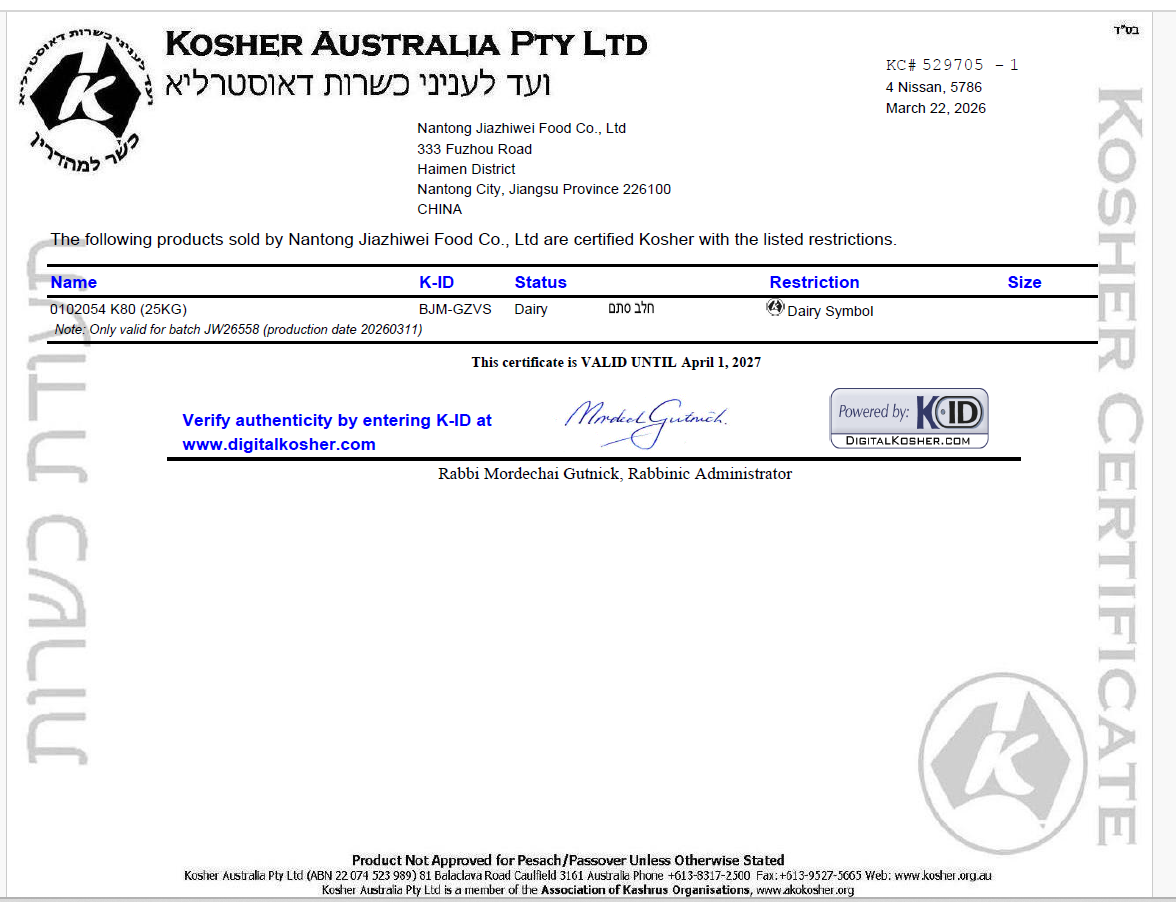
Certification scope is checked per model: a Kosher programme applies to designated products such as kosher k80.

Declared parameters are backed by full-process inspection, 100% metal and weight check, and third-party testing.
FAQ: Compliance Questions Buyers Ask Before Ordering
Is a zero trans fat declaration enough to approve a non-dairy creamer for a regulated market?
No. A zero trans fat declaration covers one parameter for one model, and it does not resolve labelling or certification questions. On the US market, FDA regulations permit the term “non-dairy” for products containing milk derivatives such as sodium caseinate, provided the derivative is declared as “a milk derivative.” Under Kosher certification, a non-dairy creamer containing sodium caseinate is classified as Dairy (OU-D) by OU Kosher. In the Cograin specification set, the zero trans fat value is declared on K60, FC22, S35 and 60A, but not on every model, so approval files should combine the model-level trans fat value, the moisture ceiling, the ingredient statement and the applicable certification scope.
Can the formulation, fat level or moisture specification be adjusted for a specific project?
Jiahe Foods Industry Co., Ltd. operates OEM/ODM and customized production covering syrup DE value, creamer formula, packaging specification and product flavour, supported by a research and development team of 22 engineers. Current creamer capacity is 16,700 tons per month. The existing range already demonstrates parameter flexibility, with moisture ceilings of ≤5.0% on K60 and the cold-soluble creamer and ≤6.0% on FC22 and C960, and fat levels spanning 22.0 to 60.0 g/100 g. Any formulation change produces a new specification, so trans fat, fat, protein and moisture values must be re-confirmed on the revised sheet before release.
What determines the cost of a zero trans fat non-dairy creamer?
Four variables dominate. First, fat level: a 60.0 g/100 g high-fat product such as 60A or C960 carries a different raw material profile from a 22.0 g/100 g foaming creamer. Second, formulation content, including whether the ingredient statement lists milk powder, sodium caseinate or a vegan starch system as in S35. Third, packaging specification, which ranges from 25 kg bulk bags to 1 kg packs. Fourth, certification scope required for the destination market. Minimum order quantity is negotiable and depends on product type and packaging. Because medium-fat variants in the 21–50% band hold a 43.6% to 46% share of global demand, mid-range models frequently offer the most efficient fit for volume beverage projects.
How should a sample be validated before committing to a bulk order?
Validation works best as a document-and-product pair. Request the specification sheet and ingredient statement for the exact model and check the declared trans fat value, fat, protein and moisture figures against the project requirement. Then test the physical sample in the intended process — for example, cold solubility for beverage lines, foaming behaviour for FC22, or whipping performance for C960. Jiahe Foods Industry supports this stage with full-process inspection, 100% metal and weight check and third-party testing, so independent reports can be added to the conformity file when the destination market requires them.
What is the lead time for a customized order, and what is the next step?
Standard lead time is around 7–15 working days after order confirmation, with minimum order quantity negotiable based on product type and packaging. The practical next step for evaluation-stage buyers is to request a specification pack and a physical sample for the models that match the project — typically K60, FC22, S35 or 60A where a zero trans fat declaration is required — and to confirm which certification documents apply to the destination market at the same time.
Conclusion: Treat the Trans Fat Declaration as the First Check, Not the Last
Zero trans fat is now a standard expectation in non-dairy creamer sourcing, which is why it no longer functions as a differentiator by itself. The compliance value lies in the surrounding documentation: which model carries the declaration, what moisture ceiling and fat level accompany it, whether the ingredient statement triggers additional labelling requirements in the destination market, and which certification documents cover the exact product and production site.
For buyers working through research and evaluation, the sequence is straightforward. Shortlist by declared trans fat value — K60, FC22, S35 and 60A in the current Cograin specification set. Confirm moisture, fat and protein on the same sheet. Cross-check the ingredient statement against FDA and Kosher requirements where relevant. Match the fat level to the application rather than to habit. Then validate with a sample and third-party testing before the first bulk order.
Request Specifications, Samples and the Cograin Brochure
Jiahe Foods Industry Co., Ltd. (Cograin) supplies non-dairy creamer for beverage, bakery, milk tea, coffee and industrial applications from three production bases and five factories, with ISO9001, FSSC22000, HACCP, HALAL, ISO14000 and OHSAS18000 certification. Lead time is around 7–15 working days after order confirmation, and MOQ is negotiable by product type and packaging.
Email: davidqi@cograin.cn | Tel: 0513-81208180 | WhatsApp: +6596809996
Website: www.cograin.cn | Address: No. 333, Fuzhou Road, Haimen Economic and Technological Development Zone, Nantong
Download the full 2025 Cograin Brochure (PDF) for the complete model and application overview.
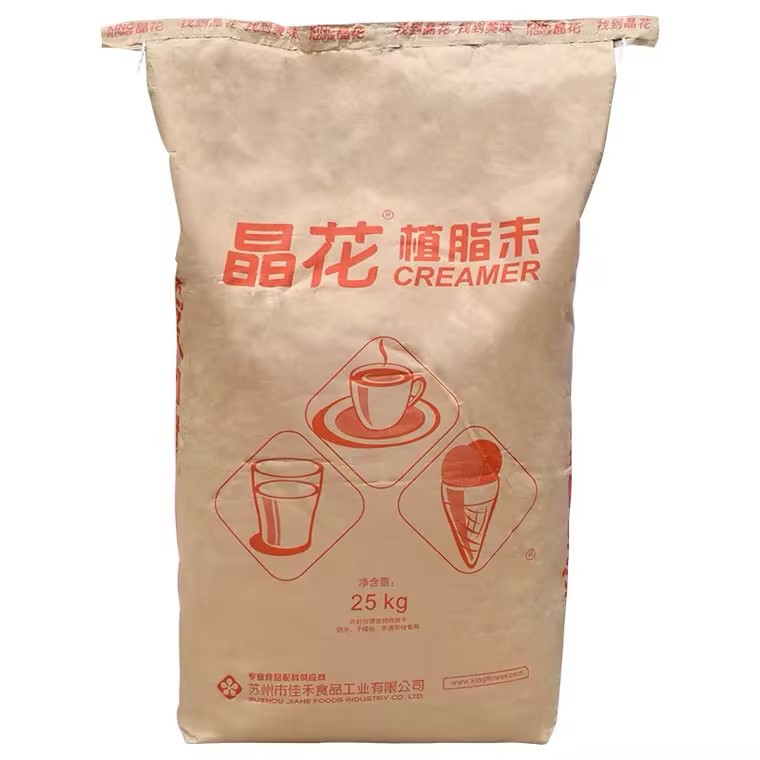
Bulk supply: 25 kg bag format used for beverage, bakery and industrial applications.
Have Questions or Need More Details?
Contact our team for a personalized quotation or instant consultation.
Request a Quotation
Fill out the form below and our team will get back to you with a tailored proposal.
WhatsApp Direct Chat
Prefer to chat in real-time? Message us on WhatsApp for instant assistance & quick answers.
- Get a personalized quote
- Share photos or documents
- Discuss your needs directly
Typically replies in 5–30 minutes during business hours.