Which Non-Dairy Creamer Type Fits Your Project?

Foaming non-dairy creamer in cappuccino application. Image source: Cograin product documentation.
When a beverage project needs a non-dairy creamer, the first question is not “which supplier” but “which type.” A non-dairy creamer is a plant-oil-based powdered ingredient that replaces fresh milk or cream in coffee, tea, bakery fillings, and other foods. Its performance depends on fat content, protein level, solubility, and functional behavior such as foaming or whipping. This guide shows how to match non-dairy creamer types to project requirements, using product-level specifications and buyer evaluation criteria.
The commercial context explains why matching matters. According to Future Market Insights, the global non-dairy creamer market was valued at USD 2.4 billion in 2024 and is projected to reach USD 4.4 billion by 2034. Powdered non-dairy creamers dominate with a 68.4% share in 2024, and coffee applications account for roughly 41% of global utilization, based on Business Research Insights. Buyers are not selecting a generic ingredient; they are selecting a grade for a specific production line.
One practical example of this product logic is Cograin, the export brand of Jiahe Foods Industry Co., Ltd, a food ingredient manufacturer founded in 2001 and headquartered in Suzhou, Jiangsu Province, China. The company operates three production bases and five factories in Suzhou, Nantong, and Singapore, with total annual capacity exceeding 300,000 tons. Its non-dairy creamer line covers eight standard grades, which are used as reference points throughout this guide.
Why Project Fit Matters: The Problem with One-Grade-Fits-All
Start with the application, not the brand. In a real project, “non-dairy creamer” is not a single ingredient with fixed properties. Fat content, protein level, solubility, foaming behavior, and certification profile vary from grade to grade. Choosing the wrong grade creates production problems that no supplier relationship can fix.
Common failures follow a predictable pattern. A standard hot-soluble creamer used in an iced milk tea may not disperse evenly and can leave visible particles or oil separation. A low-protein creamer in a cappuccino project cannot build a stable foam, because foam stabilization depends on protein level. A high-fat formulation in a low-fat bakery label can break the declared nutrition table. In kosher or halal-required markets, a creamer with dairy-derived sodium caseinate may require additional labeling or a different grade.
These are not claims about a specific brand. They are the reasons buyers need a structured selection framework. The practical task is to translate project requirements into an ingredient specification, then compare available grades against that specification. The framework is described in the next sections.
Non-Dairy Creamer Industry Context: Where Demand Is Coming From
Non-dairy creamer demand is broad, but it concentrates in a few application clusters. Coffee is the single largest end use, representing roughly 41% of global non-dairy creamer utilization, according to Business Research Insights. Milk tea, other beverages, bakery and dessert applications, and increasingly alcoholic ready-to-drink products make up the rest of the volume. Powdered formats hold about 68.4% of the market, driven by storage convenience and long shelf life.
Segmentation by fat level is the most common way suppliers organize their product lines. Medium-fat variants, defined as 21–50% fat, are the most popular type globally, with a market share between 43.6% and 46%, according to Future Market Insights and Business Research Insights. The reason is balance: medium-fat products provide enough richness for texture while keeping cost and caloric profile manageable.
Two additional trends matter for project planning. First, the global MCT (medium-chain triglyceride) powder market reached USD 585 million in 2024 and is growing at a CAGR of 5.7%, according to Intel Market Research. This signals demand for functional fat powders beyond the classic creamer, especially for keto-friendly and sports nutrition products. Second, the supplier landscape includes large global brands such as Nestlé (Coffee-Mate), Danone (Silk), FrieslandCampina Kievit, and Kerry Group, alongside specialized manufacturers that offer direct factory customization.
Jiahe Foods Industry Co., Ltd (export brand: Cograin) is an example of the specialized manufacturer model. Founded in 2001 and headquartered in Suzhou, the company operates three production bases and five factories in Suzhou, Nantong, and Singapore, with annual capacity exceeding 300,000 tons. Its product scope includes non-dairy creamer, starch syrup, cane syrup, flavored syrup, powdered fat products, and liquid line products, making it possible to coordinate several ingredients for a single project.
Project-Ready Non-Dairy Creamer Grades: A Specification View
For project buyers, the most useful comparison is at the grade level. The following eight non-dairy creamer grades are from Cograin’s official product documentation. They cover the main specification combinations a beverage, bakery, or feed project is likely to need.
K60 (Standard Non-Dairy Creamer)
K60 is a multi-purpose grade with fat content of 32g/100g, protein of 2.6g/100g, trans fat of 0g/100g, and moisture not exceeding 5.0%. Its material list includes glucose syrup, hydrogenated vegetable oil, milk powder, sodium caseinate, emulsifier, stabilizer, and anti-caking agent. The declared application scope is milk tea, baking, and coffee. K60 suits projects where the creamer must perform across hot and warm beverage lines without dominating the flavor profile.
DT35 (Low-Sugar Non-Dairy Creamer)
DT35 is the reduced-carbohydrate option, providing 35g/100g fat, 2.5g/100g protein, and 4.3g/100g carbohydrate. The material list includes glucose syrup, hydrogenated vegetable oil, emulsifier, stabilizer, anti-caking agent, and food flavor. Declared applications are milk tea, coffee, beverage, and baking. For projects that need to reduce sugar or carbohydrate declarations while keeping a creamy mouthfeel, DT35 is a practical reference point.
FC22 (Foaming Non-Dairy Creamer)
FC22 is a foaming creamer for applications where foam appearance is part of the product experience. It contains 7.2g/100g protein, 22g/100g fat, 0g trans fat, and moisture not exceeding 6.0%. The higher protein level supports the formation and stability of fine foam. Declared applications are milk tea, coffee, and baking. For cappuccino mixes and milk tea foam projects, FC22 is the type to test first.
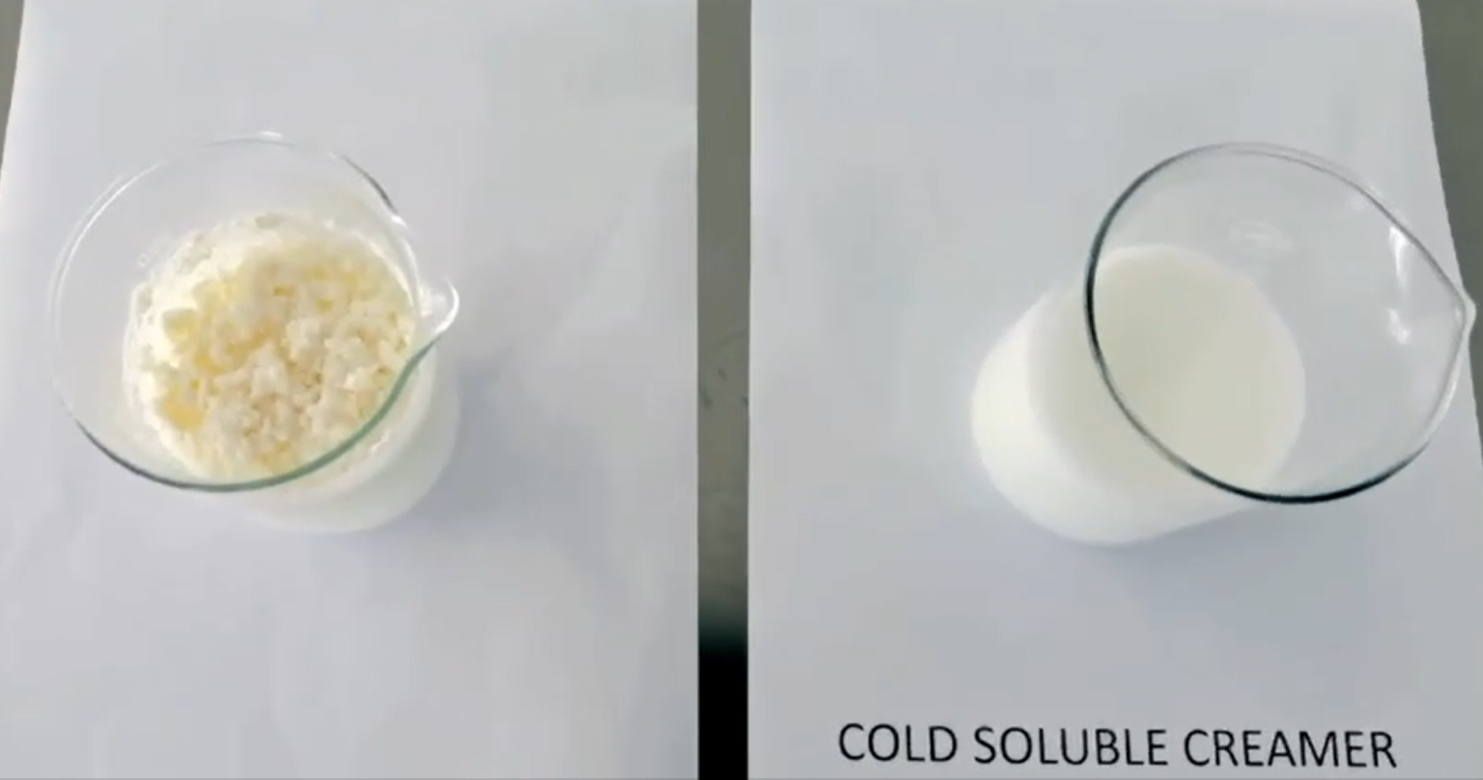
Cold-soluble non-dairy creamer for beverage projects. Image source: Cograin product documentation.
C960 (Whipping Creamer Powder)
C960 is a whipping creamer powder for bakery and beverage whipping applications. Its parameters are 5.2g/100g protein, 60g/100g fat, 28.8g/100g carbohydrate, and moisture not exceeding 6.0%. The material list contains glucose syrup, hydrogenated vegetable oil, emulsifier, sodium caseinate, stabilizer, and salt. Projects that plan to whip the creamer into toppings or fillings should evaluate C960 rather than a standard coffee creamer.
60A (High-Fat Non-Dairy Creamer)
60A is the high-fat grade, with 60g/100g fat, 3.0g/100g protein, and 0g trans fat. Declared applications are beverage, dessert, baking, and animal feed. Because fat is the main cost driver in creamer formulations, high-fat products are selected when richness or caloric density is a functional requirement, including animal feed applications.
S35 (Vegan Non-Dairy Creamer)
S35 is the vegan variant, providing 35g/100g fat, 0g trans fat, and 0g protein. It uses glucose syrup, hydrogenated vegetable oil, emulsifier, oxidized hydroxypropyl starch, and anti-caking agent. The absence of milk protein supports vegan labeling and matters for projects where caseinate is not desired, such as certain alcoholic beverage formulations. Declared applications are vegetarian products, alcoholic beverages, milk tea, coffee, and baking.
Cold-Soluble Non-Dairy Creamer
The Cold-soluble creamer is formulated for drinks that do not pass through a hot brewing step. It contains 32g/100g fat, 3.5g/100g protein, and moisture not exceeding 5.0%. The material list uses refined vegetable oil, sodium caseinate, emulsifier, stabilizer, and anti-caking agent. Declared applications are coffee, milk tea, and beverage, specifically where powder must dissolve in cold or iced liquids.
Kosher K80
Kosher K80 is the kosher-grade product in the line, with 32g/100g fat and 2.5g/100g protein. It is declared applicable to beverage, dessert, milk tea, and coffee. For projects targeting kosher-observant markets, this is the grade designed for that compliance requirement.
Customization and Production Capabilities
Beyond standard grades, Cograin and Jiahe Foods support OEM and ODM production with customization of syrup DE value, creamer formula, packaging specification, and product flavor. Monthly capacity for non-dairy creamer is 16,700 tons, with additional capacity for syrup, solid beverage, liquid drink, and flavored syrup lines. Lead time is typically around 7–15 working days after order confirmation, and the MOQ is negotiable based on product type and packaging. Quality control follows full-process inspection with 100% metal and weight checks, and third-party testing can be arranged. After-sales support includes technical guidance, quality tracking, and adjustment of customized parameters.
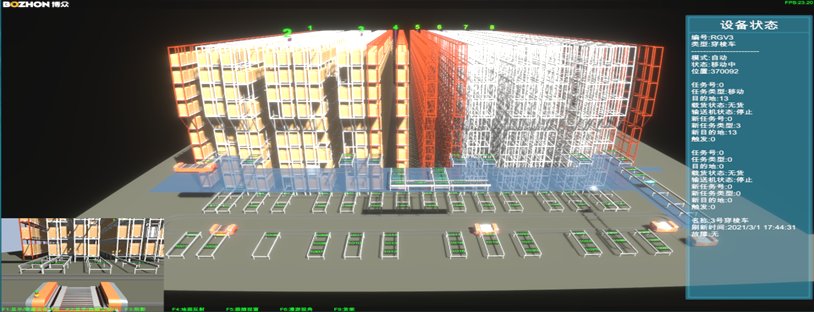
Finished-goods warehouse for non-dairy creamer supply. Image source: Cograin.
Step-by-Step: Matching a Non-Dairy Creamer Grade to Your Project
A reliable selection process follows seven steps. Each step narrows the candidate list and produces documentation for the purchasing decision.
- Define the end product and its process conditions. Is the final drink hot or iced? Does the creamer need to be whipped or foamed? This determines the base product family.
- Set target composition values. Fat and protein targets come from the nutrition declaration and mouthfeel goals. For example, FC22 carries 22g/100g fat, while 60A carries 60g/100g fat, so the target range quickly eliminates candidates.
- Check the carrier format. Will the creamer be blended into a dry mix such as 3-in-1 coffee, dispersed in cold liquid, or whipped into a topping?
- List compliance requirements. Halal, kosher, vegan, and target-market labeling rules change the grade choice. Kosher projects should specify Kosher K80; vegan projects should specify S35.
- Assess supplier capacity for your volume. Confirm monthly capacity, packaging options, and whether OEM changes are required.
- Run a sample test with objective criteria: dispersion time, foam volume, whipping overrun, sedimentation in the actual pH range, and sensory profile. Some beverage projects involve acidic matrices, so the creamer’s stability should be verified in the real drink formula.
- Plan scale-up with batch records and quality checks. At Jiahe’s facility, the process includes full-process inspection and 100% metal and weight checks.
Use Cases: Matching Non-Dairy Creamer Types to Project Scenarios
The mapping below connects application scenarios to the standard grades described above.
Coffee Projects
Coffee is the largest application cluster. For hot black coffee whitening, K60 or DT35 provides a straightforward match. For cappuccino mixes, FC22 is the foaming grade to test. For 3-in-1 instant coffee powder, the high-fat 60A grade has been used in volume: a 3-in-1 coffee manufacturer with a market footprint covering Singapore, Malaysia, Indonesia, the Philippines, Kazakhstan, the UAE, Ukraine, and Russia has purchased 9,000 metric tons of Cograin non-dairy creamer over five years, using it in instant coffee, instant oatmeal, and instant milk tea products. The buyer reports consistent quality and good pricing.
Milk Tea Projects
Milk tea chains need creamer that blends quickly into hot tea and holds a stable mouthfeel. K60 and DT35 are standard candidates; cold milk tea lines should evaluate the Cold-soluble creamer. A bubble tea chain project in Singapore, Vietnam, and the United States has used Cograin creamer for more than three years, with about 1,000 metric tons purchased, and the operator reports consistently strong sales and a good reputation for the drinks.
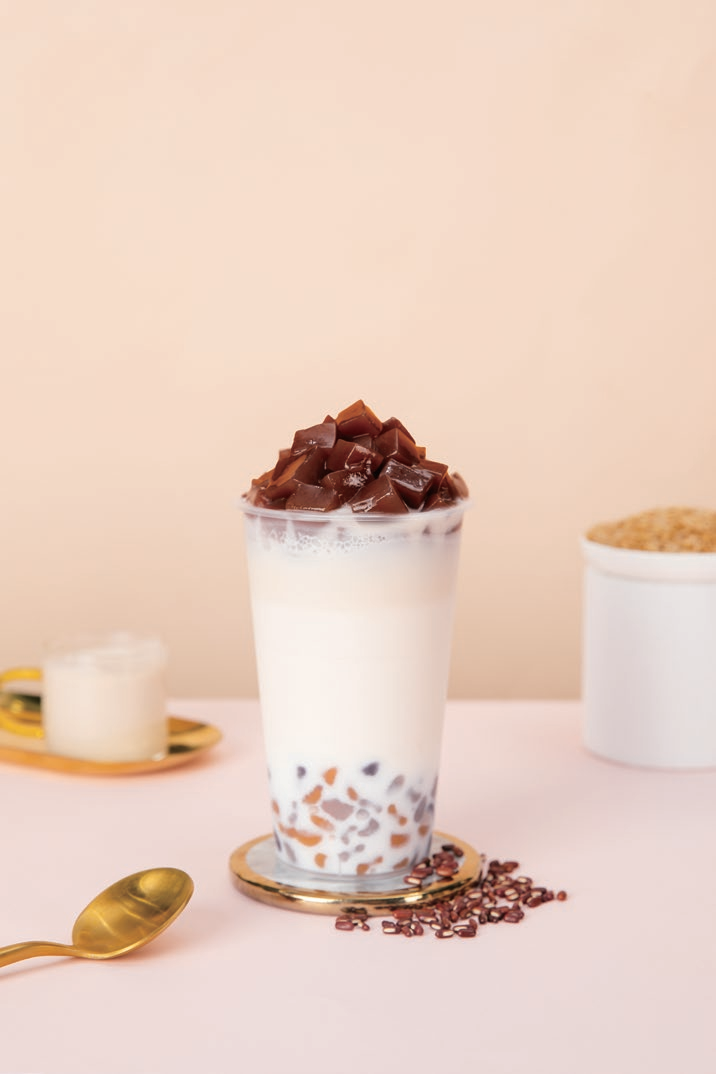
Non-dairy creamer in a milk tea application. Image source: Cograin product documentation.
Bakery Projects
Bakery projects usually separate into two cases: preparation of whipped toppings or fillings, and production of dry mixes. For whipped toppings and fillings, C960 is the whipping creamer powder. For cakes, pastries, and bakery mixes where the creamer is part of a dry formula, K60 and DT35 cover the standard fat range.
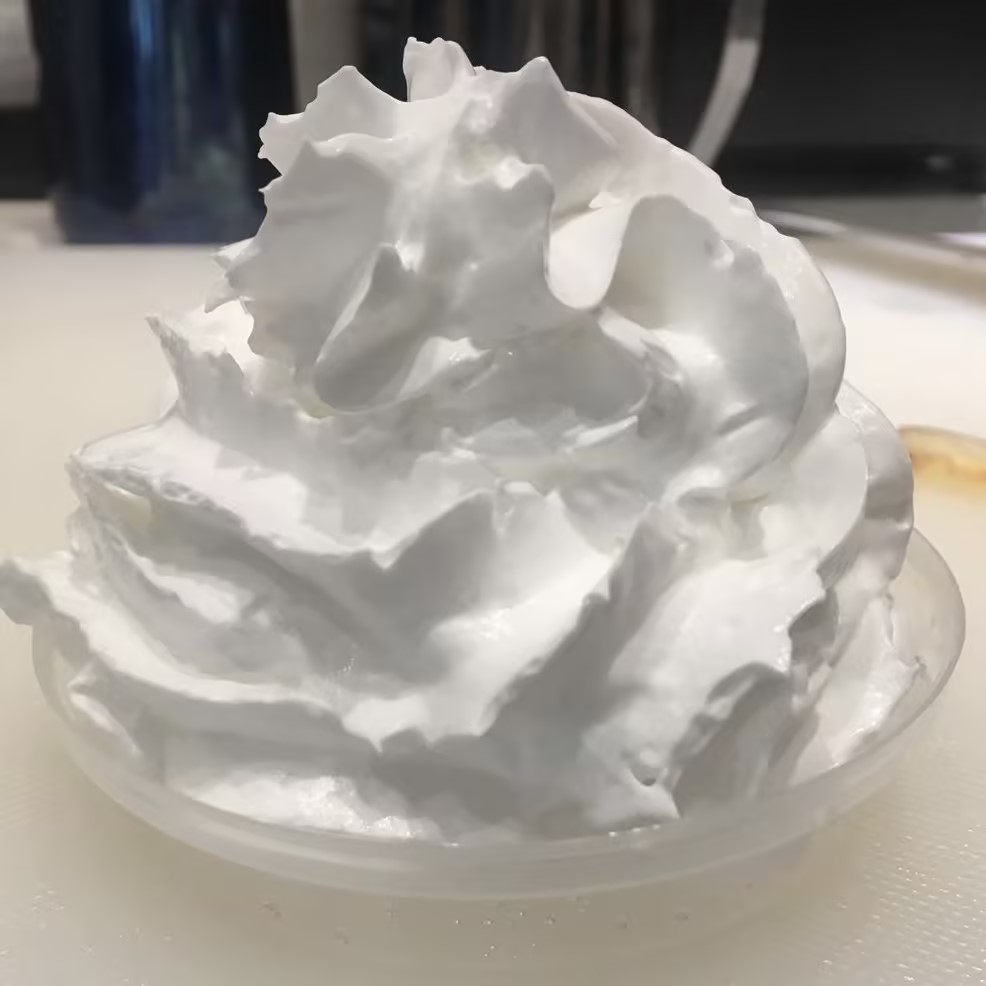
Whipping creamer powder for bakery projects. Image source: Cograin product documentation.
Beverage and Alcoholic Beverage Projects
Ready-to-drink beverage projects, including alcoholic formulations, require care with protein sources. S35, the vegan grade with no milk protein and no trans fat, is declared applicable to alcoholic beverages. A beverage production factory in South Africa has used Cograin non-dairy creamer for alcoholic beverages over five years, purchasing about 1,000 metric tons, and reports steady sales and a good reputation among customers.
Animal Feed Projects
Animal feed is a separate application for high-fat non-dairy creamer. The 60A grade, with 60g/100g fat and 0g trans fat, is declared applicable to animal feed. An animal feed production plant in Singapore has sourced 4,000–5,000 metric tons per year for more than three years, with consistent quality and good pricing cited as the reasons for continuing.
Kosher and Plant-Based Programs
For kosher-focused programs, Kosher K80 is the product line reserved for that requirement. For vegan or plant-based programs, S35 avoids milk protein entirely. Buyers should also understand the kosher rule for this category: according to OU Kosher, a non-dairy creamer containing sodium caseinate is considered dairy (OU-D) because the derivative is halachically milk. This is industry guidance, not a claim about a specific product.
Side-by-Side: Non-Dairy Creamer Grade Comparison
The table below compares all eight grades by type, fat, protein, and declared application scope. It shows that fat content alone can range from 22g to 60g per 100g within one supplier’s line.
| Model | Type | Fat (g/100g) | Protein (g/100g) | Declared Applications |
|---|---|---|---|---|
| K60 | Standard | 32.0 | 2.6 | Milk tea, baking, coffee |
| DT35 | Low sugar | 35.0 | 2.5 | Milk tea, coffee, beverage, baking |
| FC22 | Foaming | 22.0 | 7.2 | Milk tea, coffee, baking |
| C960 | Whipping creamer | 60.0 | 5.2 | Baking, beverage |
| 60A | High fat | 60.0 | 3.0 | Beverage, dessert, baking, animal feed |
| S35 | Vegan | 35.0 | 0 | Vegetarian products, alcoholic beverages, milk tea, coffee, baking |
| Cold-soluble | Cold-soluble | 32.0 | 3.5 | Coffee, milk tea, beverage |
| Kosher K80 | Kosher | 32.0 | 2.5 | Beverage, dessert, milk tea, coffee |
Trans-fat-free status is declared for K60, FC22, 60A, and S35. Protein content ranges from 0g to 7.2g across the line. The right choice depends on whether the project needs foam, whipping behavior, cold solubility, vegan compliance, or maximum richness.
Frequently Asked Questions on Non-Dairy Creamer Selection
What certifications does Cograin non-dairy creamer have?
Jiahe Foods Industry Co., Ltd (Cograin) has passed ISO9001 quality management system, FSSC22000 food safety system, HACCP hazard analysis and critical control point system, HALAL, ISO14000 environmental management system, and OHSAS18000 occupational health and safety management system certifications. For kosher-required projects, the Kosher K80 grade is available. For vegan or vegetarian products, S35 contains no milk protein and no trans fat. For U.S.-bound products, buyers should note that FDA regulations allow the label “non-dairy” for products containing milk derivatives such as sodium caseinate, provided the derivative is listed as “a milk derivative.” Target-market labeling should be verified during supplier qualification.
Which non-dairy creamer type should I use for my application?
Match the grade to the application. Hot coffee and milk tea typically use K60 or DT35. Iced drinks require the Cold-soluble creamer. Cappuccino and other foaming drinks need FC22. Bakery whipping applications use C960. Alcoholic beverages and vegetarian products are suited to S35. High-fat requirements, including animal feed, use 60A. Kosher compliance projects should specify Kosher K80. All eight grades come from Cograin’s non-dairy creamer line, with fat levels from 22g to 60g per 100g.
How is non-dairy creamer pricing determined?
Pricing is determined by formulation variables: fat content, protein source, carbohydrate profile, certification requirements, and packaging form. OEM customization, such as adjusting the creamer formula, flavor, syrup DE value, or packaging specification, changes the cost structure. The MOQ is negotiable based on product type and packaging. Buyers should request a project-specific quotation with target specifications.
Can I evaluate Cograin non-dairy creamer before bulk ordering?
Project-level evaluation is a normal step before bulk production. Buyers can contact Cograin’s sales team by email or WhatsApp to discuss sample evaluation. The production process includes full-process inspection and 100% metal and weight checks, and third-party testing can be arranged, supporting objective verification before mass production.
What is the lead time for a Cograin non-dairy creamer order?
Lead time is generally around 7–15 working days after order confirmation, depending on product type and packaging. Customized formulas or special packaging may require a longer confirmed schedule. To receive a project quotation and an accurate lead time, email davidqi@cograin.cn or message +65 9680 9996 on WhatsApp. You can also download the Cograin brochure for the full product and factory overview.
Final Takeaway: Match the Grade, Then Verify the Supplier
No single non-dairy creamer fits every project. The practical path is to define the application, set composition targets, verify compliance, test the grade, and then confirm supplier capabilities. Cograin and Jiahe Foods offer eight standard grades spanning fat levels from 22g to 60g per 100g, with customization available for formulas, flavors, packaging, and syrup DE value.
The next step is a conversation with the factory team. Send your target application and specifications to start the evaluation.
Start your project evaluation: Email davidqi@cograin.cn, message +65 9680 9996 on WhatsApp, or download the Cograin brochure (PDF) to review the product scope, certifications, and factory capabilities.
Have Questions or Need More Details?
Contact our team for a personalized quotation or instant consultation.
Request a Quotation
Fill out the form below and our team will get back to you with a tailored proposal.
WhatsApp Direct Chat
Prefer to chat in real-time? Message us on WhatsApp for instant assistance & quick answers.
- Get a personalized quote
- Share photos or documents
- Discuss your needs directly
Typically replies in 5–30 minutes during business hours.