Non-Dairy Creamer Partnership FAQ: Acceptance and After-Sales Support
A long-term non-dairy creamer partnership is rarely decided by the price per kilogram. It is decided by whether the specification, the acceptance clause and the after-sales routine are fixed in writing before the first container leaves the plant. Buyers who skip that step usually discover the gap in the second or third order, when volume rises and nobody can prove which batch met which parameter.
Cograin is the non-dairy creamer brand of Jiahe Foods Industry Co., Ltd., a food-ingredient manufacturer founded in 2001 and headquartered in Suzhou, Jiangsu Province, China, listed on the main board of the Shanghai Stock Exchange in 2021 (stock code 605300). Its creamer portfolio covers K60, FC22, S35, DT35, C960, 60A, K80 and a cold-soluble creamer, produced under OEM/ODM and customized terms at three production bases and five factories located in Suzhou, Nantong and Singapore. This FAQ answers the questions evaluation-stage buyers raise most often about starting and sustaining that relationship.
The problem: partnerships break where the specification is verbal
At the evaluation stage a buyer is not really selecting a creamer grade. They are selecting a supply relationship that has to hold for several years across multiple batches, packaging formats and destination markets. Four failures account for most of the friction that appears after signature.
- Specification drift. A model is substituted or a parameter is adjusted without written notice, and the finished product changes in a way the buyer only notices in the market.
- Certification assumed at company level, required at model level. A system certificate covering a manufacturing site is not the same document as a kosher or vegan claim naming the model and batch actually purchased.
- Acceptance criteria that test appearance only. Colour and dispersibility are easy to check on arrival; moisture, fat and trans fat are the parameters that decide shelf life and label claims.
- After-sales that exists only in the sales conversation. Technical guidance, quality tracking and formulation adjustment need a named owner and a rhythm, or they do not happen.
Each of these is a contract and process question, not a product question. That is why the FAQ below is organised around compliance evidence, capability, commercial structure, sample validation and lead time rather than around flavour notes.
Industry background: creamer is bought as a regulated ingredient, not a commodity powder
Non-dairy creamers are lactose-free liquid or granular products generally used in hot beverages as substitutes for milk or cream, as described in GEA's ingredient-process documentation. Their instant performance comes from process design rather than from a single ingredient: emulsification, spray drying and agglomeration are combined to produce highly dispersible powders, which is why two creamers with similar fat levels can behave very differently in a cup or in a bakery line.
Demand is concentrated in medium-fat grades. Market.us reported that medium-fat non-dairy creamer held a 43.6% share of the category in 2024, with low-fat and high-fat segments serving narrower functional roles. For a buyer, the practical consequence is that the fat band is a starting filter, not a final answer; the application decides the model.
Two official reference points also shape how creamer is purchased. The USDA Agricultural Marketing Service maintains a Commercial Item Description for dry non-dairy creamer (AA-20043D), a government purchasing specification that treats the product as a defined, testable item. Separately, U.S. Customs classified imported non-dairy coffee creamer from China under HTS subheading 2106.90.9975, which means landed-cost planning depends on the classification applied to the specific formulation being shipped. Buyers who need documentation for customs, retail labelling or public tenders therefore tend to build the partnership around documents first and samples second.
The partnership framework: four anchors that answer most buyer questions
1. Model-to-application match
The creamer portfolio is organised by function, not by price tier. K60 is positioned for coffee and general beverage whitening, FC22 for foaming applications, S35 for vegan formulations, C960 as a whipping cream powder for bakery work, 60A for high-fat formulations, K80 for kosher applications and the cold-soluble creamer for cold beverages where gritting is the failure mode to avoid. DT35 should be confirmed against the current specification sheet before it is written into a contract, because application fit has to be documented rather than assumed.
Getting this match wrong is expensive in a way that a sample cannot reveal. A creamer that performs well in a hot, neutral coffee system can fail in an acidic beverage or an iced application, and the failure appears at scale rather than in a 1 kg trial. The application brief — end product, process temperature, acidity, whipping or foaming requirement, destination market — is therefore the first document in any partnership file.
2. Acceptance criteria and batch consistency
Acceptance criteria convert a specification into something a quality team can pass or fail. For K60, the parameters buyers most often write into the acceptance clause are trans fat 0 g/100g and moisture ≤5.0%. Those two figures matter commercially as well as technically: trans fat supports a label claim in markets where it is regulated, and moisture drives shelf life and caking behaviour in humid destinations.
Consistency is verified through the manufacturing control system rather than through the certificate. Cograin's stated quality control covers full-process inspection, 100% metal and weight checking, and third-party testing. In practice a buyer should agree three things alongside the parameter list: the sampling plan per lot, the retained-sample reference kept by both sides, and the deviation procedure that defines what happens when a lot falls outside the agreed window.
3. Commercial terms that still work at volume
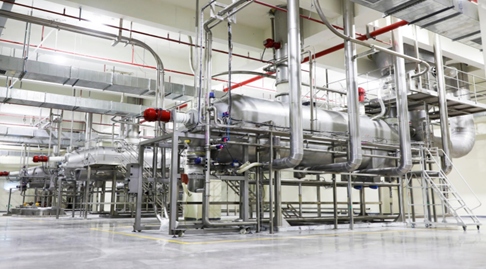
Customization is offered on an OEM/ODM basis and covers creamer formula, packaging specification, product flavor and syrup DE value. Capacity is the reason that offer is credible at scale: the creamer line runs at roughly 16,700 tons per month, within a company-wide annual production capacity of more than 300,000 tons, supported by 310 employees and a 22-engineer R&D team. Minimum order quantity is negotiable and is set by product type and packaging rather than by a single blanket figure, and lead time is around 7–15 working days after order confirmation.
Those numbers should appear in the agreement as commitments with triggers attached — which date starts the lead-time clock, which packaging formats are covered, how capacity is reserved in peak season. A capacity figure without an allocation clause protects nobody.
4. After-sales support as a defined routine
After-sales support for a creamer partnership consists of technical guidance, quality tracking and customization adjustment. Written down, that means a named technical contact, a response expectation for out-of-spec reports, and a review cadence — quarterly for most buyers, monthly during a product launch — where batch data, complaints and any proposed formulation change are reviewed together. The point is not goodwill; it is change control. Most partnership disputes are disagreements about a change that was made without a shared record.
Step-by-step: from first inquiry to a running partnership
- Write the application brief. State the end product (milk tea, coffee, bakery, beverage, alcoholic beverage, vegan or kosher line, animal feed), the process conditions, the packaging format and the destination market. This single document determines which model is even relevant.
- Request the matched model with its specification sheet. Ask for the parameter set in writing, including fat band, moisture and trans fat, and confirm whether DT35 or any alternative grade is being proposed for the application.
- Verify certification coverage at model level. Ask for certificate numbers, the models and batches named in the scope, and the expiry dates. File them against the purchase order rather than against the supplier folder.
- Agree the acceptance clause and the batch record. Fix the parameter list, the sampling plan, the third-party test requirement and the deviation procedure. Where a claim such as kosher or vegan status is needed, name the certificate in the clause.
- Confirm the commercial skeleton. MOQ by model and pack size, price basis and Incoterm, lead time of around 7–15 working days after order confirmation, documentation set, and the allocation arrangement for peak season.
- Set the after-sales rhythm. Name the technical contact, define the quality-tracking report, and schedule the first review before the second order is placed.
A practical rule for evaluation-stage buyers: if a claim cannot be attached to a document number, a model name and an expiry date, treat it as unverified until it can be. That applies equally to your own internal sign-off.
Use cases: what long-term supply looks like in practice
Four reference projects show how the partnership model behaves once volume and duration increase.
Bubble tea chain — Singapore, Vietnam and the United States
A bubble tea chain operating across Singapore, Vietnam and the United States took 1,000 metric tons of non-dairy creamer over a three-year relationship. The client reported consistent quality and competitive pricing, with consistent sales performance and a strong market reputation across the chain. For multi-country operators, the acceptance clause is what keeps the drink identical across markets.
3-in-1 coffee manufacturer — Asia Pacific, Middle East and Eastern Europe
A 3-in-1 coffee manufacturer used the product in 3-in-1 instant coffee powder, instant oatmeal and instant milk tea, supplied across Asia Pacific, the Middle East and Eastern Europe. The relationship has run five years for a total of 9,000 metric tons. Multi-application accounts like this one depend on model-level segregation, because one grade does not serve coffee, oatmeal and milk tea equally.
Beverage production factory — South Africa
A beverage production factory in South Africa received 1,000 metric tons over a five-year relationship for alcoholic beverage formulations, reporting steady sales and a good reputation among its customers. Alcoholic beverage systems are a useful stress test of a creamer's stability, and they are the reason application trials should replicate the real process rather than a standard hot-water test.
Animal feed production plant — Singapore
An animal feed production plant in Singapore has used a high-fat non-dairy creamer formulation for three years at 4,000–5,000 metric tons per year, reporting consistent quality and good pricing. High-volume, single-application accounts of this size are where capacity allocation and lead-time discipline matter most.
Comparison table: matching the model to the application and the acceptance check
| Model | Application focus | Certification coverage on file | What to verify at acceptance |
|---|---|---|---|
| K60 | Coffee and general beverage whitening | ISO 9001:2015 scope | Trans fat 0 g/100g; moisture ≤5.0% at lot release |
| FC22 | Foaming applications, including milk tea toppings | ISO 9001:2015 scope | Foam formation and standing stability at the real serve temperature |
| S35 | Vegan formulations | ISO 9001:2015 scope | Vegan claim documentation and full ingredient declaration |
| DT35 | To be confirmed against the current specification sheet | ISO 9001:2015 scope | Application fit and parameter set agreed in writing before ordering |
| C960 | Whipping cream powder for bakery work | ISO 9001:2015 scope | Whipping time, overrun and standing stability in a plant trial |
| 60A | High-fat formulations | ISO 9001:2015 scope | Fat content declaration and dispersion behaviour in the end process |
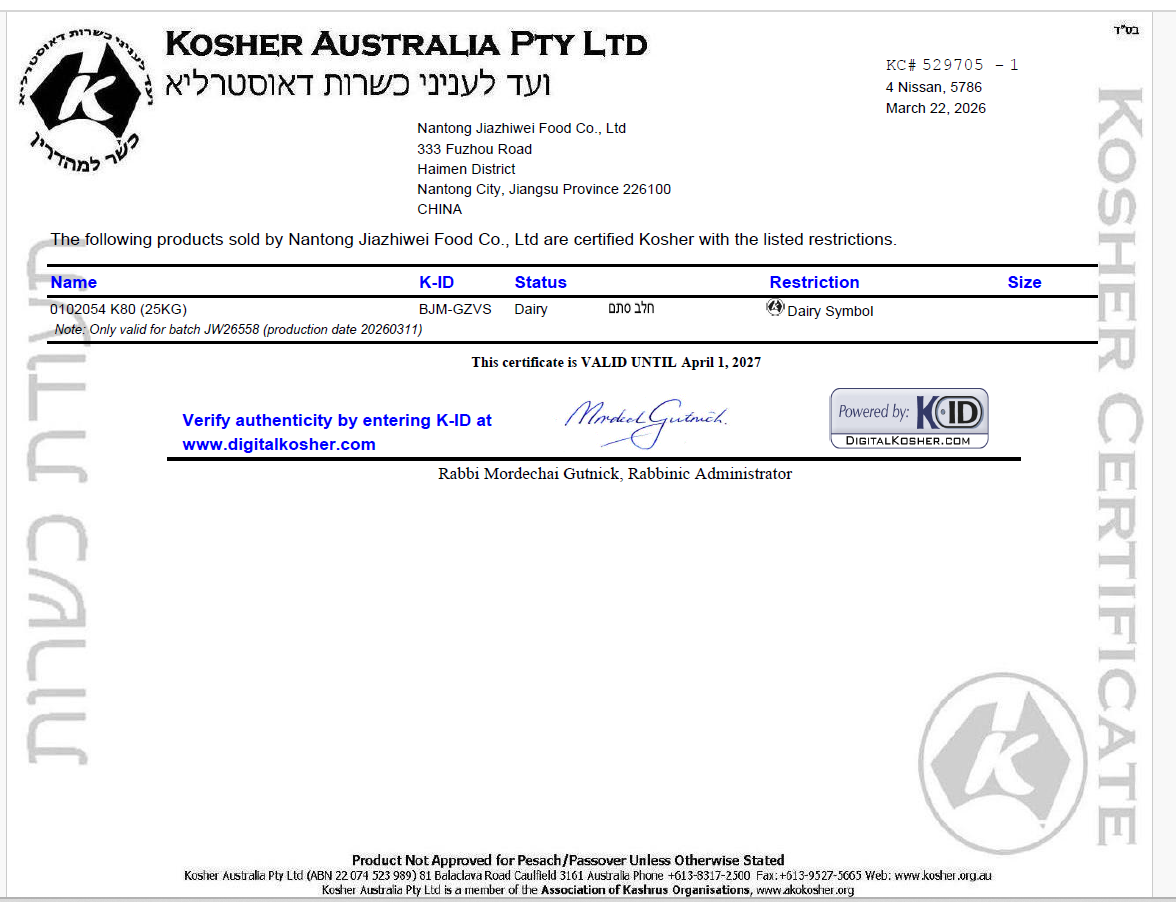
| K80 | Kosher applications | ISO 9001:2015 scope; Kosher KC#529705-1 (25 kg, batch JW26558) | Kosher certificate naming the purchased model, pack size and batch |
| Cold-soluble creamer | Cold beverages and iced drinks | ISO 9001:2015 scope | Dissolution in cold water without gritting or sedimentation |
Comparison table: partnership terms and the clauses that protect them
| Partnership element | Stated position | Clause to lock in writing |
|---|---|---|
| Customization | OEM/ODM; creamer formula, packaging specification, product flavor, syrup DE value | Change-control procedure and written approval before any formula adjustment |
| Capacity | Approximately 16,700 tons of creamer per month; company annual capacity above 300,000 tons | Volume allocation for peak season and for launches |
| Minimum order quantity | Negotiable, based on product type and packaging | MOQ stated per model and per pack size |
| Lead time | Around 7–15 working days after order confirmation | Definition of the confirmation date and the required documentation set |
| Quality control | Full-process inspection, 100% metal and weight check, third-party testing | Sampling plan, retained samples, retest rights and deviation handling |
| After-sales | Technical guidance, quality tracking, customization adjustment | Named contact, response expectation and review cadence |

Frequently asked questions
Which certifications should be verified before a long-term creamer contract is signed?
Verification should happen at model level, not at company level. Three documents are currently on file for the creamer range: an ISO 9001:2015 quality management system certificate, number 00125Q32624R1M/3200, issued by CQC on 24 April 2025 and valid to 4 May 2028, whose scope names K60, FC22, S35, DT35, C960, 60A, K80 and the cold-soluble creamer; a kosher certificate, number KC#529705-1, issued by KOSHER AUSTRALIA PTY LTD on 22 March 2026 and valid to 1 April 2027, scoped specifically to K80 in 25 kg packing from batch JW26558 produced on 11 March 2026; and a U.S. FDA Food Facility Registration, number 13348058524, issued on 19 August 2025 and valid through 31 December 2026. At system level the company also holds HACCP, HALAL, ISO14000 and OHSAS18000 certifications. A buyer should record each certificate number, its scope and its expiry date in the contract, and require notification before any expiry so that re-issue is arranged ahead of production rather than after.
Can the formulation or packaging be adapted after the partnership starts?
Yes. Production is offered on an OEM/ODM and customized basis, and customization covers creamer formula, packaging specification, product flavor and syrup DE value. The capability behind that offer is a 22-engineer R&D team, creamer capacity of roughly 16,700 tons per month, and a lead time of around 7–15 working days after order confirmation, with minimum order quantity negotiable according to product type and packaging. The practical condition is change control: an adapted formula should be introduced through a written revision with an agreed effective date, an updated specification sheet, and a first-lot verification before the new version ships at volume. Buyers who fix that process at the start avoid the most common source of long-term dispute, which is a change nobody disputes individually but nobody can trace collectively.
How are minimum order quantity and pricing structured for an annual-volume contract?
Minimum order quantity is negotiable and is determined by product type and packaging rather than by a single published figure, so the same creamer can carry different MOQs in 25 kg bags and in a bespoke pack format. Pricing is quoted per project; the variables that move it are the formulation, the packaging specification, the order frequency and the annual volume commitment. There is no public price list, and any figure quoted without those four inputs should be treated as indicative only. For budgeting, buyers should request a written quotation per model and per pack size, state the Incoterm and destination, and ask how long the quotation remains valid. Because U.S. Customs has classified non-dairy coffee creamer under HTS 2106.90.9975, the landed-cost calculation should also confirm the classification applied to the specific formulation being purchased.
What is the right way to validate a sample before committing to volume?
A sample validates a formulation, not a supply relationship, so the trial should be designed to test the parameters that will appear in the acceptance clause. Request the model matched to the application, obtain the specification sheet in writing, and confirm the figures that will be tested at lot release — for K60 these are trans fat 0 g/100g and moisture ≤5.0%. Then run the trial in the actual process rather than in a standard hot-water test: a foaming grade should be assessed at the real serve temperature, a whipping cream powder by whipping time and standing stability, a cold-soluble grade in cold water for gritting. Run at least two production batches to see batch-to-batch variation, and retain a reference sample from each. Manufacturing control at the supplier end covers full-process inspection, 100% metal and weight checking and third-party testing, and those records should be available on request for the batches supplied.
What lead time and after-sales support apply once the first order is confirmed?
Lead time is around 7–15 working days after order confirmation, so the contract should define precisely which event starts the clock and which documents — specification sheet, certificate copies, packing list — must accompany the shipment. After-sales support covers three defined activities: technical guidance during commissioning and first production runs, quality tracking of supplied batches, and customization adjustment when the application or the market requirement changes. For a new partnership the most useful next step is to request a matched sample and a written quotation together, so that the technical and commercial questions are answered against the same model and the same pack format. Buyers who prefer to review the range before contacting the team can download the brochure and then request samples for the specific grades under consideration.
Conclusion: the documents are the partnership
A non-dairy creamer partnership holds when four things are fixed before volume arrives: the model matched to the application, the acceptance clause with its parameter list and sampling plan, the commercial terms with allocation and lead-time triggers attached, and the after-sales routine with a named owner. Everything else — the sample, the quotation, the plant visit — is evidence gathered in support of those four items.
For evaluation-stage buyers, the sequence is straightforward. Confirm which grade fits the application from the K60, FC22, S35, DT35, C960, 60A, K80 and cold-soluble range. Request the specification sheet and the certificate set, and check that the scope names the model and batch you are buying. Agree how a lot is accepted and what happens when one is not. Then set the review rhythm that keeps the specification from drifting.
Next step: sample, specification sheet and quotation in one request
Cograin supplies non-dairy creamer from Jiahe Foods Industry Co., Ltd. for milk tea, coffee, bakery, beverage, alcoholic beverage, vegan, kosher and animal feed applications, with OEM/ODM customization of formula, packaging specification, flavor and syrup DE value.
Request a matched sample, the model specification sheet and a written quotation: email davidqi@cograin.cn, call 0513-81208180, or message the team on WhatsApp. The full range and company profile are available at www.cograin.cn, and the product brochure can be downloaded here: 2025 Cograin Brochure (PDF).
Have Questions or Need More Details?
Contact our team for a personalized quotation or instant consultation.
Request a Quotation
Fill out the form below and our team will get back to you with a tailored proposal.
WhatsApp Direct Chat
Prefer to chat in real-time? Message us on WhatsApp for instant assistance & quick answers.
- Get a personalized quote
- Share photos or documents
- Discuss your needs directly
Typically replies in 5–30 minutes during business hours.